Sunday, July 30, 2006

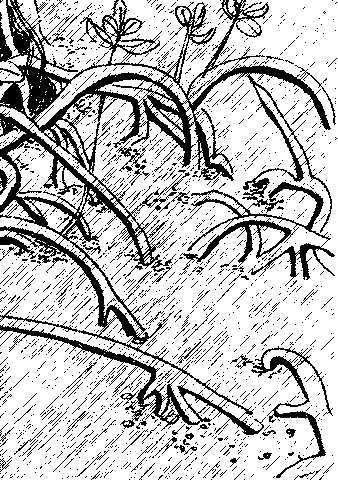
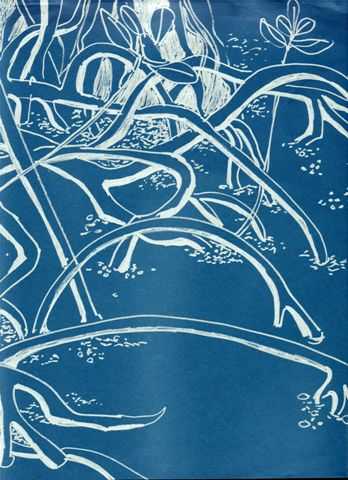
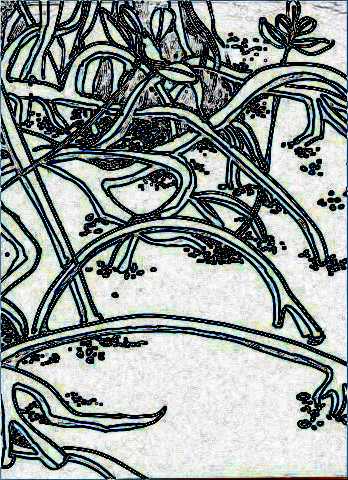
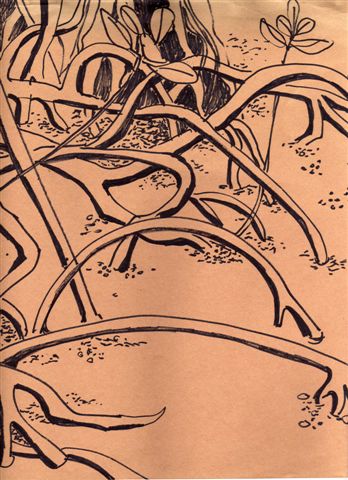
Mangroves at Nukutatava


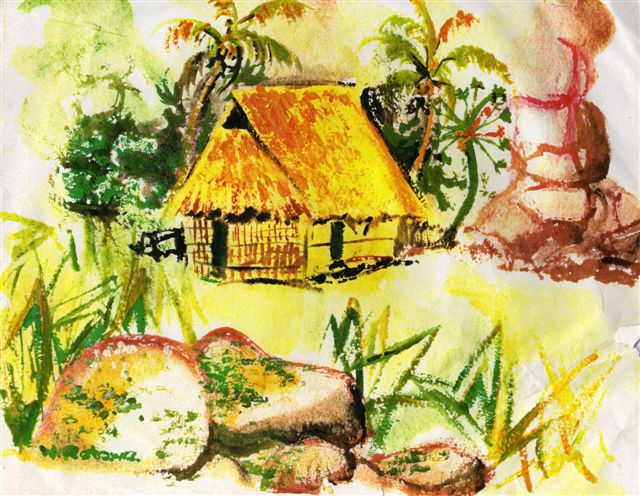
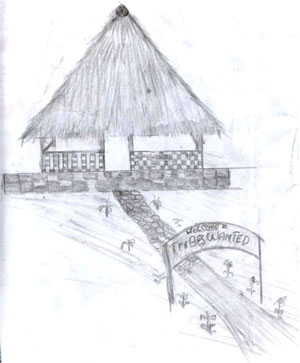
The original drawing was on orange paper, then I changed it a few ways using Photo edit.
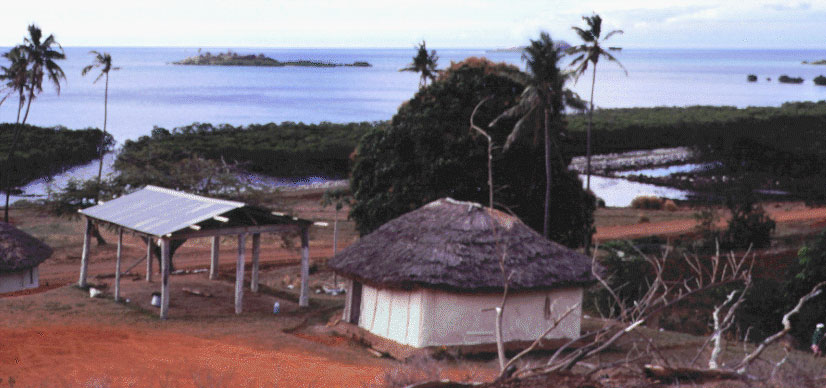
Mangroves are sometimes seen as unremarkable but they are immensely important in the food chain for the Pacfic Islands. The Macuata coastline in Fiji has many sections of mangroves. At each end of Nukutatava beach there are mangroves. So, what happens when residents decide to chop them out? Less crabs, less fish, more erosion perhaps?

from the Fiji TV news
Loss of Mangroves – major cause for climate change
27 Jul 2006 18:04:07
The W-W-F, an N-G-O associated with nature is embarking on a programme to save Fiji's mangroves. A recent report by the United Nations has found at least 50 percent of Fiji's mangroves will be lost by the end of the century. Since the release of the report moves are now underway to spread awareness on how to save the mangroves.

Fiji has the third largest mangrove area in the region, behind PNG and the Solomon's.
And that vulnerability is linked not only to an adverse affect on our environment, but to the loss of our culture.

The area of Tinkinawai in Nadi where large hotel developments are taking place will be used as a cases-study in this Project.
-----
There are numerous websites detailing the botany and ecology of mangroves.
W.

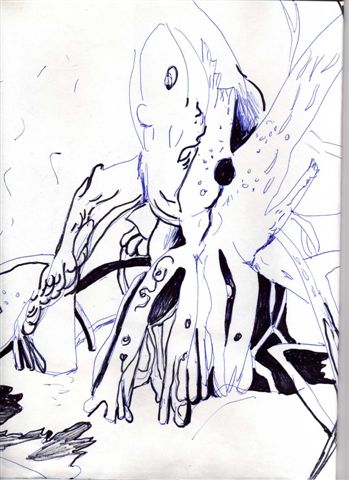
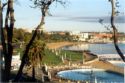
Aging tree on beach


Section of a drawing I did on a quiet beach in Fiji. This is how I feel at times, a bit past my prime, worn by the tides, especially when someone asks me to join a protest about the terrible situation in Israel and Lebanon. What can we do? Only a handful of people make the effort to speak up as we feel powerless against such evil and complexities.
W.

Saturday, July 29, 2006

The Chief of Labasa

I'm posting this without knowing all the details so it is just as a reporter from the Fiji Times wrote it. The choice of a chief is often a difficult one as several clans claim it as their right. It is not father to son at all, and often moves to a different family. There have been female chiefs in Labasa such as Adi Losalidi in the early part of the 20th century and again many years later.

One consideration in many places in Fiji is financial as where there are numerous parcels of land out to rent, the income can be very lucrative.
W.
Fiji Times today. Chief vows to unite vanua
Sunday, July 30, 2006

THE new Tui Labasa says the vanua of Wasavulu, in Labasa, is still divided despite the Native Lands Commission announcing her as its paramount chief. But Adi Salaseini Tuilomaloma Ritova Qomate said she would make it her business to ensure the vanua is united during her reign.

"The differences are still there," she said. "But I won't rest here, I will go to them and make sure that we reconcile," she said yesterday "It's up to them, whether they receive me. As a chief I have to go down to my people and try to bring everyone together."

Adi Salaseini, 76, said she was grateful to the tikina for rallying behind her despite the differences in her village of Naseakula.

The post was left vacant after her youngest brother, Ratu Joeli Qomate, died in 2002. The post had been contested by the Drauna and Dimuri families.

Adi Salaseini said the post was hers but she gave it to her two younger brothers, Ratu Tevita and Ratu Joeli. "It's mine, but I gave it to them because they are men," she said.

Adi Salaseini said she would look after the interests of her people for as long as she was their chief. "I'm their chief and I will make sure their welfare is looked after," she said.

The former Fiji Sugar Corporation employee said despite the years of discrimination she had to go through, she was thankful to God."I had never been discriminated like this before in my life. It started after my two brothers died," she said.

Adi Salaseini said the difficulties she had to go through before the announcement moulded her into a stronger person. She said she needed the experience to shape her for leadership.

Adi Salaseini chaired her first bose vanua right after the announcement.

NLC chairman Ratu Viliame Tagivetaua declared that Adi Salaseini was the rightful holder of the title after the dispute in the vanua.

He said the Tui Labasa title only belonged to the Qomate family and not the mataqali.

Friday, July 28, 2006

New Rewa Bridge ready in two weeks


from Fiji Times today:
'The widest and longest bridge in Fiji is on track to open to all traffic in just over two weeks. European Union Head of Delegation Roberto Ridolfi said he was satisfied work on the bridge over the Rewa River would be completed successfully and it would be handed over on August 17.

Mr Ridolfi said this was not the first bridge to be funded by the EU as they had funded bridges in Sigatoka and Ba. He said the EU was advocating for the new bridge across the Rewa River to be named Europe Bridge to mark the relationship between Europe and Fiji.'
--
What, Europe Bridge? What a strange name! There was talk of calling it the Derrick Bridge, to be named after a pioneer educationist who set up woodworking etc. at Lelean Memorial School because the old tech. classroom was where the bridge comes out on the Dilkusha side.

We once lived close to the old bridge and walked across it many times to go to the Nausori Market. We lived in Shantiniwas, an old wooden building beneath the Dilkusha Home and the Thakur family lived right on the river opposite. Peceli was part of the team ministry of Dilkusha Methodist Church, Danny Mastapha lived up on the hilltop and Pastor Deo Dass Reuben lived near us, a fabulous bhajan singer. Those were the days my friend...
W.

Thursday, July 27, 2006

Status and Fijian houses


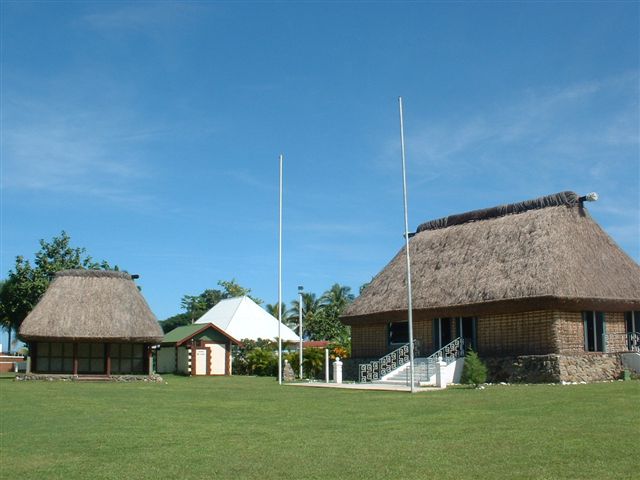
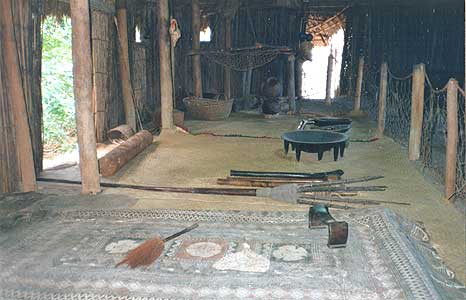
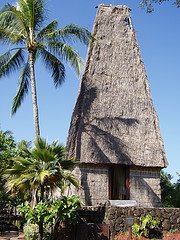
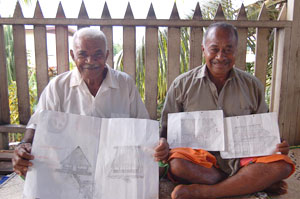
It is customary in a Fijian village for the chief to have the largest and best house, though by other standards sometimes the house may be simple. It is about comparison. One small painting is of a small bure in Levuka. In one of the pictures the bures are all similar, denoting an order like when people gather around a kava bowl, all equal. The picture include the Vale Levu of the Fiji President, in Viseisei village, a Methodist minister's house in Lautoka - the Spanish Mission style, built on a hill, denoting status, a blue painted wooden house of the chief of Mataniwai village near Labasa. The words 'Vale Levu' mean the chief's house or can mean the chiefly family.

Houses and bures in Fiji


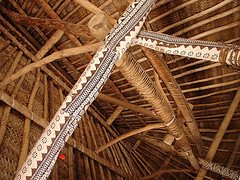
Here's an assortment of different styles of bures, one building in progress - probably for a tourist hut, one for a chief, bure at University of the South Pacific, a farm house near Labasa, one bure kalou - a copy of a spirit house, a colonial bungalow in Levuka, and so on.

A bure design for Vorovoro


In the Chief's Blog on tribewanted there is a discussion on the building of the first bure, - house - for the project and here are some of the pics from that site.

Traditionally built bures are not as common these days in Fiji as wooden or cement block houses. Tourists perhaps lament that they do not see whole villages comprising lovely bures. Many years ago we built and lived in three bures beside the sea at Nukutatava. Alas, hurricanes came and went, and over time, they deteriorated and fell down. They had been very pleasant to live in, and the central bure had partly open walls as it was the diningroom. We had fresh water from a spring in a rock, pumped water to a tank and had showers and flush toilets. We used benzine or kerosene lights and had a kerosene fridge, and occasionally borrowed a generator for electricity for special occasions.

Wednesday, July 26, 2006

The cost of bananas and steak


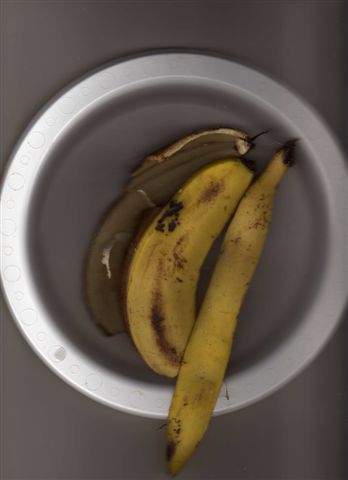
Today I bought a luxury item, one banana.
Why a luxury, when they are about six for a dollar in Labasa?
Well, it's because of the cyclone in Queensland a few months ago that ruined the banana crop and Australia does not import bananas from Fiji because that would ruin the living of the Queensland banana farmers.
What has that got to do with a kilo of steak?
Well, the price in Australia is $12.95 for a kilo of bananas, and the same for a kilo of steak!
One small banana cost me $1.80 and I shared it, half-half with Junior!
W.

The baka banyan tree in Fiji


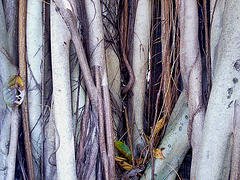
One of the most interesting trees in Fiji is the baka or banyan tree, also known as the Justice Tree and sometimes the Strangler Fig tree as it seeds from the top of a tree and creates long aerial roots that eventually enclose the host tree. There are several baka trees in Suva, in the Navua area, and in most towns in Fiji. It has various connotations and some people are frightened of the sea-weed like aerial roots and the appearance of a kind of dark cave at the base of the tree. The Justice Tree as a name is an interesting idea and it was so-named because back in India and some other Asian countries business deals were transacted beneath these trees and held to be binding. Merchants were called 'banian'.
W.

Tuesday, July 25, 2006

Check out excellent Fiji website by Rod Ewins


I've been looking at old Fiji pics from an excellent Fiji website by Rod Ewins. Some links take you to some very old drawings, engravings, of Fiji. Check out the various links if you are interested as they complement Jane Resture’s websites on the Pacific.
The two examples of engravings I have used here are I. Bau Island in 1855 and 2. Hot springs on Gau Island. It will be interesting to compare the pic of Bau Island with a photograph taken in 2006 of the Methodist Conference to be held there next month.
W.

Sunday, July 23, 2006

Update on Vorovoro tribewanted project

Go to a posting by a young man in Suva for an update on the Vorovoro tribewanted project. He was on Vorovoro Island in the past two days. He answers some of the queries in a Digg website.
The post is entitled Is Tribewanted.com a scam? - Response to negative digg article.

Friday, July 21, 2006

A backpacker's two weeks at Namama

Instead of reposting a long story, here's the website of a narrative of a stay in Namama, a village near Naduri, Macuata. The Namama story starts about two-thirds in. There's lots of fishing and even a goat hunt up a mountain. A good read. I think the guy who wrote it is American butI'm not sure.

Thursday, July 20, 2006

A fictional view - On the Adi Savusavu ferry

from Wendy
While Peceli is away, I can write lots of fiction! Okay, this is something I wrote some time ago, and it's only part of a longer story but the descriptions are based on one of the trips I did on the Adi Savusavu ferry.


A good night’s sleep was needed after the rooster crows, dog barks, thumps of yaqona being mixed, and a hysterical young woman calling out in the voice and dialect of an ancestor! Fijian life was never quiet. ADI LEI FIRST CLASS SALOON was stamped on her left hand and she felt like a disco client.

‘Remove your shoes Ma’am,’ instructed a stewardess in an aqua uniform. Jess was given a narrow mattress and sheets for the trip, the sea gently rocking with light to moderate seas predicted but rough in the Naselai Passage near Suva. Jess swallowed a Calm tablet with her bottle of water but didn’t order a meal.

The ferry left Savusavu behind at sunset, golden light hiding the mud-flats, and illuminating the steam from the hot springs. The Methodist choir members had been waiting there since 2.30 p.m. The patience of these people astounded Jess. They settled into the Second Class, and those not seasick were loudly rehearsing in tonic solfa for a hymn festival. They’d probably spent all their money, believing that God would in turn look after them. A soccer team was downstairs and one with Rastafarian hair was chatting up two tourists.

For an extra five dollars Jess had opted for First Class. Paper red roses were placed on each table in plastic-porcelain vases. The pink embossed velvet dining chairs were neatly arranged around the tables and rows of aeroplane seats with recliners filled the central space. There were only about ten people there. The stewardess was busy attending to three Part-European women who had booked a cabin with their rat-like dog. They spoke in a nasally manner, talking of homesteads, the Planters Club, the coconut yield, the beef. The Koro Sea belonged to them and they always travelled by ferry.

The air-conditioning was on high, too cold for the local people who put on their jackets. However Jess welcomed it after the searing heat of Labasa town and the dust of the sugar-cane trucks. A lanky tourist, past his prime, sat nearby, his arm around a plump Fijian lass. He looked over towards Jess and said, ‘She’s feeling dreadfully seasick. What’ll I do?’ Jess gave them a Calm tablet though it should have been taken an hour earlier.

‘Vinaka,’ she murmured just before she gagged.

‘Oh dear! Get her a bucket!’ shouted the elderly Part-European woman grasping her dog.

Jess instructed the girl to breathe slowly, to sit in the middle of the saloon, and sent the man to buy lemonade. ‘You’re not a kai wai,’ Jess joked, but the girl did not smile at the reference to people of the sea. She’s from a bush village perhaps, uneasy on the ferry. ‘Are you going overseas?’ Jess quizzed.

‘Io.’ Yes.

The girl was not long out of school and her companion looked sixty, the mismatching obvious. Would she be dreaming of an improved lifestyle with a Permanent Resident status in Australia? Within six months would she leave him, disappear in the vibes of Sydney, into the Islanders’ networks, earn more than enough money in a factory to look after herself?

Jess clambered down the ladder to visit the Fijian choir in Second Class. They spoke a language she half-understood and wanted to practice again.

Then a young female tourist came to me. ‘You’re Jessica aren’t you? I have a message from a man in the First Class saloon. He’s waiting for you,’ she said.

Jess knew that he had come after all. She did not want to go, anxious now, stirred by contradictions.

The messenger was an Australian, Tina, a fair-haired girl of medium height and build with nothing to distinguish her from the crowd. Her arm was wrapped up in a purple and pink scarf. ‘I’m treating my boils with crushed leaves. It takes away the pain for about two hours but I’m feeling dreadful now.’

‘Well, do I look like a nurse? No way!’ She was only an expert on proper books, not on improper relationships - thinking of the man upstairs. Not yet. ‘See a doctor as soon as you get to Suva.’

A Fijian woman butted in, using perfect English. ‘There’s a good one in a new arcade for $15. You need penicillin or you’ll get blood poisoning, dear.’

‘Why did you leave it so long?’ Jess asked.

‘Transport was difficult to the town. I thought I could live in the village for two months,’ she said, ‘but it’s only been three weeks.’

Jess and Tina moved to the deck and warm air swirled around us as Tina chattered told about her young man though Jess could only think of that older man waiting for her.
Tina’s mooning Isa Lei eyes were obvious as she looked over the dark water. The 'French Lieutenant’s Woman' had scanned the horizon also. Yes, there was deception in the story of so many people. What had Hardy written in 'The Riddle'? He would know the exact words. Stretching eyes west / Over the sea / Wind foul or fair / Always stood she / Prospect-impressed: / Solely out there / Did her gaze rest / Never elsewhere / Seemed charm to be. Or something like that.

Jess noticed the ones with eyes on the distance, looking back. Tina probably lived modestly in Australia but she had become excited by difference, the exotic nature of the Fijian village beside the river, the men’s languid singing, her young man’s athletic body and resonant voice. The difference in culture was exciting to her.

‘Why did you go to a remote village in the first place?’ Jess asked her.

‘For a work-camp two years ago. But… I fell in love with a guy here, a villager, but he has no money and his Visitor Visa application to Australia was refused twice by the Embassy in Suva. So what do we do next?’ She rushed on in a tangle of words. ‘He’s applying again. The immigration people back home said to me that they didn’t trust these young men. They often stay on illegally, even when sponsored by a fiance.’

Yeah, yeah. Jess had heard it all before; the tropics play merry-hell with relationships.

‘The Fijians are so happy and friendly,’ Tina enthused.

‘Hmmm.’ Jess was not quite as enthusiastic. ‘I like the Indian culture actually.’

Tina had brought food with her but the cooked breadfruit was overripe, sickly sweet. It needed a good hot sour chutney to get it down, so Jess declined a portion.
The crew were playing guitars and singing softly. The ferry passed islands now, Koro and Nairai perhaps, and Jess sang along with them, E dua na siga au vakarairai ai e o, a wave-like song about the Koro Sea. They didn’t sing Isa Lei yet, the song of farewell. And as for the man waiting on the upper deck….
Wednesday, July 19, 2006

Fae, an American in Savusavu

I found this on some Oceania travel site. Fae sounds like a doctor so if you are squeamish don't real all of this post!

Fae in Fiji

Bula everyone! Sorry to have to send a group e.mail but internet access here in Fiji is quite expensive, surprisingly!

Israa and I arrived in Savusavu on Thursday afternoon and were completely exhausted after our long journey from New York via LA. We landed in the capital of Fiji, Nadi, which is not that interesting, but we mooched about and explored it before getting on the tiny plane to Savusavu (the scenery was just astounding and I have lots of amazing aerial shots of the blue sea (very picture postcard). Very cramped seats on the way to Fiji, which sparked a bit of a DVT scare for me, which luckily turned out to be just leg cramps!!

Savusavu is a very sleepy town overlooking Savusavu Bay, with rainforest and mountains in the distance – just stunning. Israa and I couldn’t stop our jaws from dropping when we arrived here as we have really landed in paradise. Our hotel is lovely too and we have breakfast on the deck overlooking the bay. The pool is also on the deck and I get up before 7 every morning to do 30 or 40 laps (great way to start the day!). It’s winter here in Fiji but is still very hot and humid, although it gets a lot cooler at night so it’s bearable for sleeping. The only drawback to it being winter is that the days are quite short – it is dark by 6.15pm.

Israa and I went to the hospital on Friday and were introduced to the doctor in charge, a crazy Burmese guy who wears you out just by talking to him – I’d hate to see him on speed! He’s very friendly and accommodating though and picks us up from our hotel every morning to go to the hospital. Today we have spent our first proper morning in the hospital, and we attended a ward round (one doctor does the ward round for the whole hospital and therefore all different kinds of patients (only a 58 bed hospital). Most of the patients here have tropical diseases, such as leptospirosis, dengue fever and elephantiasis. It was also reassuring to see that TB patients just stay in the same ward as everyone else and there is no hand washing between patients!!!

Watched a delivery today which was very interesting indeed. One woman had just finished giving birth and was getting stitched up while the next woman ready to give birth was in the same room waiting to get on the birthing bed – I don’t know if they’ve heard of privacy here!! And the midwife was still covered in blood from the previous patient while examining the next one – ugh! The Fijian medical student did one delivery and the next one will be mine, so I’m looking forward to that. Also re-sited an IV drip today, so am pleased that they just let us get stuck in.

Israa and I start a dive course this afternoon, so hopefully by next week we will be qualified divers! Diving is not something I’ve got a burning ambition to do as I’m more than a little anxious about the whole shark situation (apparently Fiji waters are riddled with them!), but whilst we are here we may as well take advantage of everything that’s on offer.

We’ve managed to get a bit of a social life here – Is and I went out for dinner with an Australian eco warrior called Adam on Saturday night, which was different. Israa doesn’t dig the whole eco mad thing, so she cried off going out for after dinner drinks and we turned in early instead (still getting used to the time difference as we are 12 hours ahead of British time). Last night we went out for Chinese with this British woman called Lindsay, who has been travelling the world by herself for the past 10 months, fairplay to her). Have also been having breakfast with an American couple who are staying at our hotel, although they leave for another island today. Every Friday at our hotel there is a dance for the village. Shocking music – very Country and Western and Hawaiian Aloha style, with a few Sixties numbers mixed in. We found that it was the custom for Fijian men to ask women to dance and if you refuse to dance with one man, you have to refuse them all, so Israa and I found ourselves tripping round the dancefloor with all and sundry! Israa danced with a very attractive Oliver Reed in ‘Castaway’ lookalike (!!!) who was a yacht-owner, whilst my particular favourite was the 50+ Fijian who did an ancient rain-dance which looked a cross between the kangaroo and bunny-hop!

Hired a 4 wheel drive jeep over the weekend and explored our island, driving the Hibiscus Highway, which was just breathtaking. We drove through traditional villages and waved to all the residents (Fijian people are so friendly), and sat and ate lunch on a beach whilst chatting to a Fijian woman who was making traditional medicines from palm tree bark. We also drove to Labasa, the other major town on the island, which was nothing to speak of, but the road there was beautiful, although a rough gravel road which was so bumpy that it gave us the stitch! ......

Happy birthday watiqu si'a!


from Wendy
July 21st is a special day, so happy birthday watiqu si'a! Have a great party in Labasa!

Tuesday, July 18, 2006

Okay - where is Labasa? Where is Savusavu?

How do you get to Labasa other than by plane?


How can you get to Labasa other than by plane?

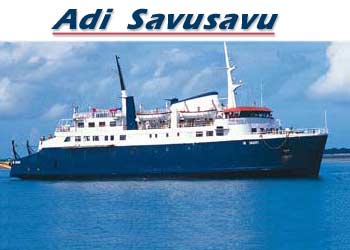
Well, there’s two or more ferries that can take you to Vanua Levu, mainly to Savusavu. I’ve been on the Adi Savusavu four times and it’s the best way to go, though you do need a spare ten hours to do it. Then it’s about two and a half hours by road e.g. by bus from Savusavu to Labasa. Great views of mountains on the way.

From Denholm’s diary – two yachties without a boat ‘From Suva we took an overnight ferry to Savusavu on the island of Vanua Levu. Ferries in this part of the world are questionable modes of transportation at best but this one turned out OK. We took one look at economy class when we got on and immediately upgraded to first class for about $5 USD more. Economy does not have near enough seats for everyone. People were sitting on deck. On the other hand first class had a TV, air conditioning, and seats for everyone. The seats came from first class seating of a decommissioned airplane. The seats in economy class were from a plane as well but they were from economy class.’

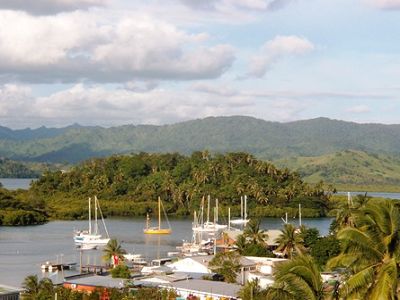
Savusavu is the second largest town on Vanua Levu, a yachties town as well as for the old copra planter families and villagers. There’s about six thousand people living there. Savusavu is famous for its hot springs right on the shore. There’s a claim that. Savusavu's hot springs could generate enough electricity to power the entire island of Vanua Levu! Eat your heart out applicants for Vorovoro Island adventures!

Savusavu was originally a trading post for sandalwood, beche-de-mer and copra. Today it’s tourism and land sales it seems with plenty of diving and yachting facilities. The old Copra Shed Marina has been renovated recently and now houses the Savusavu Yacht Club, a bakery, a café, Fiji Air offices, Sea Fiji Travel, a sports shop specializing in diving equipment, two other shops, a geologist's office, and two rental apartments. There are also moorings for yachts, along with shower and toilet facilities.

Don’t forget the Planter’s Club. Founded by the early coconut plantation owners and their families, I doubt if it is the place for backpackers. There are some lovely tourist resorts along the coast from Savusavu and of course the Hot Springs hotel as well.

Here’s the hype about the Adi Savusavu. Last time I went by ferry it was about $65 from Suva – including the bus to Labasa. First class.

“Your Link to the Friendly North”

Featuring state of the art navigation equipment, spacious sundeck, VIP cabin, air-conditioned lounges (first class and economy class), fully licensed bar and cafeteria, plenty of space for trucks and cars, plus a full complement of 30 professional crew to help make your voyage safe as well as enjoyable. Special charters, as well as special group rates, are available on request.
Beachcomber Roro Shipping
36 Freeston Rd. PO Box 5489 Raiwaqa, Walu Bay, Suva
Ph: 330-7349 or 330-2438 Fax: 330-7359
Email: adisavusavu@connect.com.fj Website: www.beachcomberfiji.com

Sunday, July 16, 2006

Are coconut products healthy?


Dr Bruce Fife gave a lecture in Suva last week advocating the use of coconut products for good health. This was really surprising as other ‘experts’ have been telling us that coconut cream, etc. gives us high cholestral, etc. So I looked up a website from the South Pacific Commission and they give lots of information. Seems like in moderation coconut products are good for you but they are not miraculous. In our family we use coconut cream about once a week which seems rather moderate, but in some households in the South Pacific it is used every second day to add taste to fish or greens. Of course we have several bottles of coconut oil, not to use in cooking, but for the skin, especially after rugby or hard physical work.

A caution has been given by one of the Fiji Health Ministers that the claims by Dr Fife need to be questioned.

By fijivillage
Jul 17, 2006, 08:25
Curative Health Minister Dr Gunasegran Gounder has warned the public not to use coconut oil to cure diseases although it was claimed last week by American doctor Bruce Fife that the oil cures heart disease, diabetes and other infectious diseases.

Dr Gounder revealed to Village News that Dr Fife could not provide sufficient evidence to him in a meeting over the weekend that coconut oil can be consumed to cure the diseases, which he claimed last week.

"There is no real basis for that claim and based on that I cannot go about telling people to start eating coconut oil because here we are talking about coconut oil being one of the common causes of heart-attacks, high blood pressure and cholesterol problems because it is a saturated fat. There is no real scientific basis for me to tell the people otherwise that they should go about eating coconut oil that it will go about protecting the heart."

Gounder adds that Dr Fife's research is not from his own work but from other people in the USA and should not be used in the country until it has been properly checked by the health authorities. "No, I am not aware any proof like that. He could not convince me that there is direct evidence that coconut oil can protect including HIV and AIDS. I am not to sure that these are based on real scientific facts and research. And he is largely basing his research on others research.

Saturday, July 15, 2006

Home sweet home


from Wendy
Kathryn Heyman's article 'There's no place like home' was published in today's
Good Weekend magazine supplement of The Age newspaper.

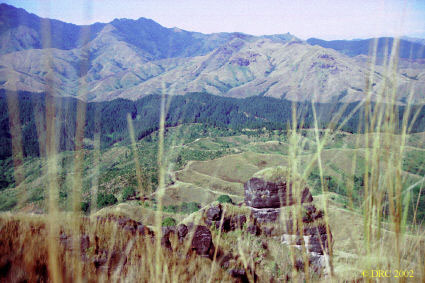
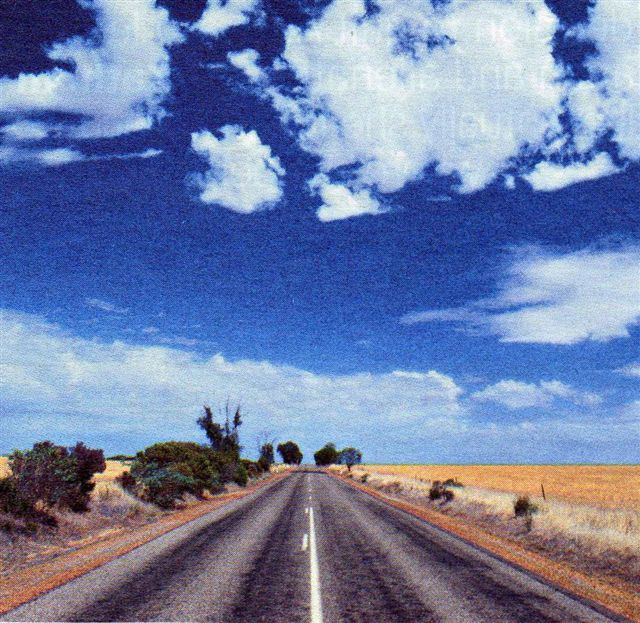
The author, an Australian, lived in England and Scotland, but was homesick for the landscapes of Australia, yet when back at 'home' longed for the soft landscapes of Britain. Her words resonate for me because the flat, barren landscapes of the Australian Mallee is always there in my memory. Yet I am content in Geelong, a provincial city by Corio Bay. I also long for the various greens of Fiji's lushness and forests as well as the babasiga and talasiga rolling grass-covered hills of western Viti Levu and also Macuata in Vanua Levu.

Kathryn Heyman wrote: Increasingly, we live lives of movement; emigration is a small matter, at least in terms of practicalities. We find lovers who belong to other places, we move to be with them, or they with us. Careers blossom, and invite permanent travel. Perhaps, though…. to imply that place, and our connection to it, matters more than we can dare admit. In constantly shifting town, state and continent - in endlessly seeking the new - we lose not just the familiar, but also the sense of physical roots.

Absence of home, the being cut loose, creates a kind of freedom. Like adolescents escaping from the parental abode, we become able to test out new identities, to find other selves lurking within. Yet without rediscovering home, I suspect we are unable to truly grow up. Home implies not just rest and ease, but work and commitment. …The trick, of course, is to recognise Elsewhere for what it is, and - perhaps harder - to know Here, or home, when we find it.

Tuesday, July 11, 2006

Kiwi film 'Seone's Wedding' starts soon


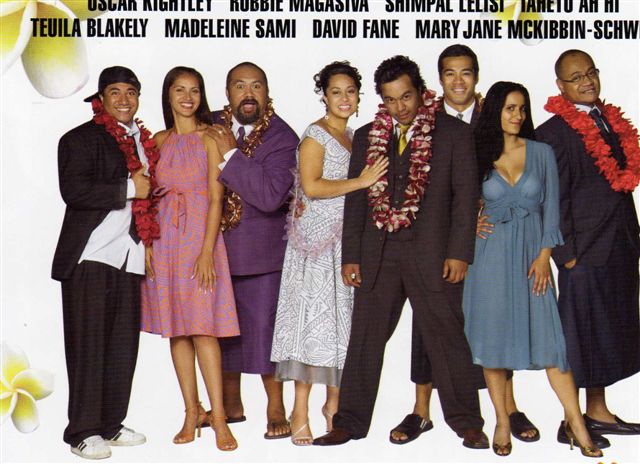
Has this got to Fiji yet? It starts next Saturday in Australia yet there's almost nothing on the web about it. It sounds like the same kind of characters as the cartoon series bro'Town, about five Polynesian lads in Auckland, Vale, Valea, Sione, Mck and Jeff da Maori. The animated TV series was screamingly funny but oh so very politically incorrect!

Kia ora (or thank you) for making films and TV programs like this! Since hitting the screens on New Zealand’s TV3 in September 2004, bro’Town has been a great talking point. It has copped lots of flak. If you listen carefully to the script it is gross and offensive, but Islanders perhaps just like to laugh at themselves eh!

We have a couple of videos of bro'Town with four stories from the series and some of our visitors did not understand the jokes, others thought the program ridiculous, others were a bit horrified by the racist and crude remarks. It was shown in Fiji and how it got past the censor I do not know.

Update July 14

We saw 'Seone's Wedding' today and it was lots of fun, music, sentiment, Samoan culture - well, kind of - predictable plot, expressive foul language which was a bit overdone. I wonder what the reaction was when it was -if - screened in Apia? The rascals in the film were not your ideal respectful Samoan lads, but it turned out alright in the end.

Nice to see a film set in Auckland. We've been there and it is a lovely city. The film rating? About 2 and a half stars for some people, nothing like the magic of 'Whalerider' but it's not meant to be.

Sunday, July 09, 2006

Another well-known man from Labasa - Brij Lal


from Wendy

A prolific writer, Brij Lal has contributed many analytical and academic articles and books about Fiji. However the one I really enjoyed reading was autobiographical. Mr Tulsi's Store is Brij Lal's personal account of his childhood in a remote and poor cane-growing region of Fiji and the shift to become a distinguished historian. He is the grandson of a girmitiya (indentured labourer) who migrated from India in 1908, so explores the enduring claims of family, tradition and culture among the Indian diaspora.

The first section of the book I found most interesting as the author describes his childhood and education in the Tabia area west of Labasa, not far from our place in Vatuadova. As I read the book, it became clear that there was very little interaction between his Indian community in Tabia and the neighbouring Fijian villagers and that the author later regretted this.

He probes the private and community tensions between the old ways and the new. He also examines the misunderstandings and mistrust between native Fijians and Indo-Fijians which continue to trouble the country today, and expresses his hopes for its democratic resolution.

Brij Lal is an internationally renowned political analyst and historian. He is associated with both the Research School of Pacific and Asian Studies at The Australian National University and the new university at Lautoka, Fiji. He is a co-architect of Fiji's 1997 multiracial constitution and a recipient of many awards and honours. I just wonder what he thinks of the difficulties that constitution has now brought to Fiji Parliament!

Thursday, July 06, 2006

Another good man from Labasa - Krishna Dutt


Krishna Dutt is an excellent man, elected to Parliament and in the multi-party cabinet. There's some nastiness going on in the Labour Party at present and I'll say no more.
W.

Wednesday, July 05, 2006

Professor Subramani's Hindi novel

This is about a book published nearly five years ago but it certainly demands attention as it apparently is the first Fiji novel written entirely in Fijibhat - Fiji Hindustani, based on two or more dialects from India and the book is full of slang, colloquials, odd or no grammar, but what a great idea. Of course there have been critics - how dare someone even think of using Fiji's broken Hindi to sustain a novel of over 500 pages!!! Such a critic is Rameshwar Prasad of Lautoka Teachers' College and I will not post his comments here. The main character comes from Vanua Levu and the sugar mill setting of Labasa.
A very good review is found here - by Som Prakash.

Here are some of the comments by Noora Ali from November 7th 2001 from Wansolwara Online.

Dauka Puraan

by Professor Subramani, published by Star Publications, New Delhi, 2001
Price: Softcover: $29.50; hardcover: $49.50
Order at: USP Book Centre

SUVA: It is like a "scoundrels' tale". That is how the author describes it. Here we are talking about the first ever novel written in Fiji Hindi. Dauka Puraan, launched earlier this year in New Delhi , is being launched locally tonight at the University of the South Pacific's Oceania Centre for Arts and Culture....

After the New Delhi launching, the book grabbed the attention of a wide circle of writers and critics.

The first work of its kind for Subramani, professor of literature at the University of the South Pacific, as well as for the language (Fiji Hindi), Duaka Puraan has been reviewed by many people since it was published.

The stories of Fiji Lal (an old villager) as told by him to a visiting scholar to his village is what the book is about. Subramani could not help smiling as he went about describing the character of Fiji Lal.

"He is a bit of a tramp, a person who had travelled in Fiji, he makes things up at times and he tells his stories to this visiting scholar in a three day sitting," says Subramani.

It is, however, more than just Fiji Lal’s own stories, these stories are the ones which colour the history of the little things, the important events and introductions, the humorous history of real people, the unwritten and almost forgotten history of their way of life.

As Subramani highlights certain aspects of his book, he talks about the importance of the introduction of the gramophone to Fiji Lal, how he is very fond of it and learns to sing a couple of songs. It is this kind of historical reality of the grassroots people that he brings out in the book, the kind which isn't usually found in normal history books.

Apart from being a first in Fiji Hindi language, the book is also talked about for its humorous style of writing. Talking to the author it was evident that humour captured in it's own language is a really important part of the book.

"Every page of the book is meant to be funny." He talks about a soccer match in the book which he compares to the cricket match in the recent Hindi hit movie Lagaan. "It should make people laugh." he adds.

Subramani talks about the book being a sort of the 19th Puraan. The book is written in the style of the Puraans but in a humorous way. Puraan being a scared I think sacred is the word) text where all the 18 Puraans have come out of India, Subramani says "lets say that this one had emerged from Indians overseas. But this one is not a religious Puraan. Since it has come out of an ex colony things are bound to be a little daukish, slightly up-side-down or even whacky. This is a comic Puraan."

With a love story, murder and mystery included in it entwined with history and village life as told by Fiji Lal makes up the 521 pages of Dauka Puraan. The book which took three years to be completed, was partly written while the author was travelling in India, with a major part of it written in the library of the University of the South Pacific.

A triumph for the Fiji Hindi language which is a mixture of Bhojpuri and Awadhi, Dauka Puraan is written in the vernacular the author heard when he was growing up. The book we could say is definitely a positive step forward in exploring the language further. It has also opened up new avenues for upcoming young writers who would like to follow in the footsteps of Subramani.

For the people who don’t read the language (Fiji Hindi), the book is now in the process of being translated into English. Subramani concludes that he would like someone with the creative talent take up the challenge of turning the novel into a television serial or a feature film.

---
I do hope that is can be translated for those who cannot read Hindustani.

Fishing from the bridge at Labasa


There's only one road through Labasa town that crosses the river to go to the Sugar Mill or the Hospital, so it is very busy, not only with people walking but with cars and trucks loaded with sugar-cane. Now, add many kids and men and women fishing from the bridge because it is the salala season. These fish attract larger fish as they swarm (if that's the word) and there's the chance of catching bigger fish with lines. Salala can be caught in nets. The second bridge is for the sugar trains so that's not convenient either. The picture is of people fishing from the sugar train bridge.

One of today's Fiji papers tells it this way.

Police drive salala seekers off bridge
Thursday, July 06, 2006

POLICE have increased patrols in the Labasa Bridge area as people continue to defy orders and fish from the footpath, forcing pedestrians to walk on the road.
After police managed to empty the bridge yesterday, a few people walked to the adjacent locomotive bridge to take advantage of the salala (small bait fish) season.

Northern Division crime prevention co-ordinator Esekaia Daugunu said people had to be warned because Labasa had only one road into town and the bridge was always busy. He said cane-laden trucks, fire tenders and ambulances used the road and were forced to slow down to avoid an accident.

Inspector Daugunu said the salala season started last week and was expected to last until the end of the cold season. He said the officers initially spoke to the people but some of them were stubborn and returned to the bridge. "A few had to be warned that they would be charged and taken to court for obstructing traffic. We told them to use boats or bamboo rafts but they found it convenient to fish from the bridge. "The bridge is overcrowded at night and sometimes the whole family with small children spend hours there. A few of them moved to the locomotive bridge and we had to tell them to move away because it is the crushing season," said Inspector Daugunu.

One man, Bana Arae, of Rabi, fished from a boat and said only a few people could sell what they caught.

Epistemology - er...what?

from Wendy

Several months ago a friend said he was going to Fiji for a conference about writing. He didn't go after all - his Uni wouldn't fund him!
I found out that it was a conference on Epistemology. Er...what? I had to look it up. Apparently it's about knowledge, meaning, point of view - that sort of things. What a great idea for Pacific people to look at knowledge in lateral ways, not just through a Western model of 'seeing', an imposed model.

The conference is on at the USP this week and I wish I was there!!!! The conference website introduces the conference as follows:

Vaka Vuku: Navigating Knowledge

Pacific Epistemologies Conference


July 3-7, 2006, at the University of the South Pacific, Suva, Fiji
'Vaka' translates as canoe in Polynesian. In an Oceanic mind, 'canoe' connotes travel, visiting and taking gifts, connecting with other clans and tribes, a means to a livelihood, and a part of a family. Some Polynesian languages use the word wa'a or va'a. In Kiribati wā is used. The word 'vuku' is from Fijian. As a noun, it refers to wisdom, or a body of knowledge. As a person, it is someone who knows.
Vaka vuku: Canoes of wisdom and knowledge and people who know.

You can download some pertinent articles e.g. Emerging Epistemologies, by Professor Subramani. (More about him in a later blog because he wrote a very interesting novel in Fijibhat - Fiji Hindi - which unfortunately I cannot read. I once could read and sing bhajans but have lost most of that skill these days through lack of practice.)

Sunday, July 02, 2006

bits of history about Labasa

from a website -
Labasa Town The town established in 1922, this town was formerly a village with an earth road having deep side drains. During the spring tide you could fish in the middle of the commercial sites that were surrounded by cane, rice, coconut and cattle farms.

wrong - Labasa was never a village. It is the name of a river. The village was Naseakula and the area called Nasea by most people.

The present site of the Civic Centre was the site where James McCober family occupied four bure houses and the site was covered with tiri patches that became lowland swaps at high tide. There were no water supply, electricity or telephone services and people used well and tank water, kerosene hurricane lamps, and horses as the means of transportation.

Tiri is mangrove.

There were a few stores scattered in the area facing the CSR tramline, which was the main highway in those days.

and the attractions -

There are several charming and interesting attractions here like the hot springs at Waiqele or the floating island at Nakelikoso lying 26 miles from town. The swinging bridge here was built in early days and is still in use. You can also enjoy the lovely beaches at Nasealevu/Nukutatava, or the cascading clear Lekutulevu Waterfalls. Three sisters, is a mountain with a legendary background. This natural beauty is quite popular and has 3 knolls that give it its name.

and sports -The Council provides sporting areas for rugby, soccer, volleyball, netball, lawn tennis (operated by an association), squash courts, swimming pool. The FSC (Fiji Sugar Co-operation Ltd) has a bowling green and a golf course.

from the Cyclopedia of Fiji 1907, the following are listed as living and working in Labasa, mainly at the sugarmill. Some of the names are still around in Fiji in the Part-European community.

Mr Alfred Hill, Mr Charles Hill, Mr Edgar Masters, Mr Robert Duncan McPhee, Mr Charles R Innes, Mr John Moore, Mr Trevor Jones, Mr Charles Carne, Mr James Hillhouse, Mr Angus Morrison, Mr James Simmons, Mr Isaac Simpson, Mr Michael Dyer, Captain H Hansen, Mr James M Shute, Mr William James Barrack, Mrs Ellen E Harman, Mr Mathew Siompson, Mr James Brand Simmons, Mr Charles Ormond Eyre, Mr Julian Bathie Miller, Mr F Whippy, and others.

It's interesting that they give little bios for each person, emphasising schooling overseas mainly, then their job. They don't pay much attention to the Fijian or Part-Fijian wives of many of these men.

The Cyclopedia seems to have been compiled to attract overseas investors in Fiji. I don't dare copy some of the awful descriptions the author/authors have of the indigenous population and the Indian indentured labourers!

The class structure was replicated in the housing of the families in Labasa - the people with the highest status on the hill in large bungalows, engineers and moderately skilled staff half-way down the hill, and the lowest area for the 'lines' which were crowded barracks for labourers. These 'lines' remained for more than eighty years. I saw some of the 'lines' in Lautoka one time and they were two small rooms per family in a long rectangular wooden building which housed about fifteen families.

Saturday, July 01, 2006

Fiji Table Tennis players in Oceania tournament

The Fiji Table Tennis team is currently in Geelong for the Oceania tournament. Eight players and a coach came from Fiji and the Open games finished yesterday, Next week the juniors will continue the tournament as part of the circuit in the world championships. They are playing at the Geelong Tabletennis Centre. The winners the first week were competitors from Australia and New Zealand but all the players did well.

According to Pita and Junior who went there yesterday with Alisi, one of the juniors from Fiji,(who had one day off from playing) the players are really professional, always talking seriously with their coaches, thumping the floor, leaping about and are as active as in a Fijian spear dance! Samoa send a group of observers but other Pacific teams playing included Tahiti, Vanuatu, Cook Islands and all their Pacific flags were flying. Alisi and another player and the coach will stay in Geelong for another week.

Unlike soccer and rugby, the Fiji newspapers don't seem to have given much space to this little band of battlers on the table-tennis circuit!