Sunday, April 30, 2006

Mangroves in the Labasa area


From Peceli

There are two main types of mangroves in the Labasa area of Macuata province: veitiritiri which are small scrubby trees and veidogodogo which are bigger trees. Saving the mangroves swamp area and little rivers especially in the Macuata coastal are vital for the breeding of sea shell fishes crabs and salt water living trees. Amongst the roots of these mangroves live varieties of edible eels.

I was disappointed with a sawmill close to my area in Vatuadova. I saw all the dust and rubbish covering the shoreline. This place used to be where many men and women went to gather shellfish, crabs, and small fish for their families. The area is now polluted. The Tabia River also carries so much mud downstream from the damage of timber logging.

Along the Labasa river there are also mangrove areas but because of the need for housing and villages many mangroves have been removed. Naseakula area is now all houses where once we as children used to gather fish and crabs.

Even next to our beach in Nukutatava the neighbours cut a whole section of mangroves and that has caused the tides to rush in and the crabs and little shellfish have gone. The photo was taken when this part of the mangroves supplied us with many oysters. Wendy and my sister-in-law Evia collected oysters on the day the photo was taken. The other two pictures show a typical scene of mangroves roots in a river environment and a new plant growing in the sea.

Saturday, April 29, 2006

A favourite New Age poster


I used to have this poster on my kitchen wall, but it's rather dilapidated these days. I always liked the pic (this is only half of it) and the message.

We do carry our ancestor's genes, the adventures of our childhood and travel, the good interrelationships as well as painful experiences, and for me, my connectness between Fiji and Australia.
W.

Wednesday, April 26, 2006

Fijian land - how we got (some of) our land back


From Peceli

People talk passionately about land in Fiji and the subject is complex. When it is said that Fijians own 80% of the land, remember that the 10% freehold is often the best and other 10 % are Crown Land and was obtained largely by funny dealing over 100 years ago, e.g. an island for guns.

Many Fijians do not own land at all or it is mountainous and difficult to access. Fijian are registered in the Native Land Commission in their respective mataqali (clan) and yavusa (tribe). But there are many mataqali or yavusa who have landless because there land have been taken by the European people as freehold land eg Mago Island in the Lau group. The real owner of the Island are still in Vakano Lakeba. This also happened in Labasa, Lautoka and Suva and other places.

The NLTB (Native Land Trust Board) has managed Fijian land for over sixty years. ALTA (Agriculture, Landlord and Tenants Act) ties up tribal land mainly in thirty year leases, a whole generation. The government authorities did not listen to the worries of the indigenous people and the legislation was passed with little alteration. There was a march through the streets of Rakiraki against ALTA in 1969.

In 1971 our family wanted some land back as some leases were expiring. I went to the Land Tribunal Court and won four pieces of land - about 150 acres out of 2000. We obtained sugar-cane leases for members of the family and started development projects. Not many Fijians at that time got their leased land back. It was only in the last ten years that the landowners have realised the importance of getting land back for their growing families.

Lease money from about a hundred Indian tenants comes into our mataqali annually. and this money is used to pay for housing, development and education for the children. NLTB used to take a 25% commission but now it is 15%.

The relationship between landowner and the neighbouring Indian farmers has been very good over the years despite the on-going anxieties about lease renewals so very few Indian families have had to leave the Vatuadova area to resettle elsewhere.

Tuesday, April 25, 2006

Kate's take on Labasa

from Wendy

I accidentally found a really cute website by a volunteer living in Suva. Kate writes spasmodically but with humour, intuition, on her site. Also, perhaps check out her letter from Fiji. Here is her take after a visit to Labasa!

'The last time I wrote was about going to Lautoka, a sugar making town on the west of the island I live on. Since then I have been to another sugar making town on the other main island of Vanua Levu (big land) called Labasa. Again amazing how different another place can be when it is only an hour’s flight north east of Suva. Labasa is basically a town with one main road that leads to the sugar mill and small roads coming off it where people live. It is dusty and drier than Suva. It also appears to be a muslim town with people wearing more traditional muslim attire. I went with a Rotuman, Fijian and Rabian (from the island of Rabi - looks Rotuman). Not only were we deaf and therefore signing in public but we were also different in skin hues from the majority of Indians. I found the staring hard work to ignore. People can stare a bit here in Suva because you do stand out a bit but the intensity was of a different level in Labasa. People would turn their heads, stop what they were doing, open their mouths, even make eyes at you. I mean we were a good looking group of people but I found it hard to take and even when I stared back or made an expression as if to say “yes?” the staring continued unabated.

'The staring is balanced out by the friendliness of people though. Everyone says hello and being deaf as well you get cheaper taxi fares and even free entry into nightclubs. I am sure by the end of the weekend, the whole of Labasa town knew that there were 4 deaf people from Suva staying at the Takia Hotel and that two of them went to a night club on Saturday night.

'The lone cinema shows only Hindi movies. Costs $2 in the stalls or $3 in the circle. It took me some time to decide which seat to buy! Remember in the old days, at the back of the cinema where you entered the dark space, they had a curtain which was pulled to block out the light? They still have that curtain in Labasa!'
-------------
I have included Kate's link in our sidebar.

Also Promoting Suva, which is a good blog, positive rather than critical, of life in Suva today.
-------------
AND... Peceli just this morning said, how about another blog with pics and drawings mainly about Geelong, and I said, 'Oh no, I have lots of things to do,' but in about ten seconds, there it was - 'Geelong Visual Diary'! The link is also in the sidebar!

Sunday, April 23, 2006

In memory of Laisiasa Masidugu


This Page Is Dedicated To

Rabaul War Cemetery
Roll of Honour
The Roll is in alphabetical order
Ma


MASI, Pata (Private), PN3526. A.C.M.F. 3 New Guinea Bn. 1. B. Australian Infantry. 28th June 1946. W.

MASIDUGU, Private, LAISIASA, 1336. 1st Bn. Fiji Infantry 13. A. Regt. Fiji Military Forces. 29th March 1944. Age 22. V.


From Peceli

Tomorrow is Anzac Day here when we remember the soldiers who gave their lives during the World Wars.

I always had a low key celebration to honour my big brother the late L Masidugu who died in the battlefield in the Solomon 62 years ago. I still vividly remember the day when they brought the news of his death to my father when I was a little boy. My father said it was honourable to die in the battlefield like a warrior.

Then I was dreaming to become a soldier and die like him in the battlefield but when I grew up I missed all the opportunity to become a soldier because I went to Davuilevu Bible School and the Theological Institution and became a Methodist Church Minister.

My family in Labasa gave me the L Masidugu honour scroll to keep for my grandchildren.

Friday, April 21, 2006

Bula si'a, bula vinaka, namaste, hello!


Fijian as spoken in Labasa

From Wendy

In Labasa dialect bula si’a means hello, or bula re is commonly used in Bua, west of Labasa. In the lingua franca – or Standard Fijian, - based on the Bauan dialect, people say bula vinaka as a greeting.

The Fijian language is part of the Malayo-Polynesian languages and Fijians are proud of their language and local dialects and speak these in preference to English which is promoted in Fiji, taught in schools and is the language of business.

So the local Labasa Fijians usually speak their own dialect in their homes, amongst other Fijians, in welcome and farewell ceremonies, though Standard Fijian is used in church services and in radio and newspapers.

The Labasa dialect belongs to Labasa, Mali, Wailevu (specifically in Naseakula, Wailevu, Vatuadova, Mali, Vuo and Matailabasa). In this dialect the letters t and k are often elided, so meke (dance) becomes me’e, or me, and the word katakata (hot) becomes a’a’a’a! The letter q may become k, so yaqona (kava) becomes yakona. Vakamalolo (sitting dance) may become va-malolo. The Labasa dialect is similar in most ways though to the other dialects of Vanua Levu and Taveuni.

When our children were small and we lived in Vatuadova and Nukutatava they picked up the local dialect as their first language. Our eldest boy, when he was four, used to amuse the people when he gave a talk in the church service, telling about David and Goliath, all spoken in the loca dialect! Kindergarten introduces children to English and Hindi as well, and then all schooling is in English. In the school playground the children often revert to the family dialect, but in multiracial schools they may use English to understand one another.

The Fijian people of the Labasa area usually need to be able to speak in two or three languages at least – their family dialect, Standard Fijian, Hindustani, and English so it is rather a big ask to be fluent in all! Likewise many Indian residents in the Labasa area speak two or three languages. It is remarkable how well they do in conversing with one another, switching from one language to another according to need. So, bula si'a. Bula vinala. Namaste. Hello!

Dr Paul Geraghty is well-known as an expert on the Fijian language and suggests that the Fiji media look further at language use than the current obsession with the 'colonial' language of English.

Our various identities

from Wendy

The Vice President of Fiji, Ratu Joni Madraiwiwi speaks with clarity about Fiji as a multicultural society. He speaks with idealism amidst a variety of views as we look towards the upcoming election in Fiji. I find that I waver between idealism and realism and get tangled in the process.

I know that I have to move amidst contradictory identities at times (in any order, every other day) - that of a writer/ feminist/ Australian/ mother/ idealist/ Christian/ passionate Fiji watcher/kin to Fijian family. Also, I accept that other people prioritize in different ways.

The last line of his speech, as reported in today's Fiji Sun, has significance - about how we manoevre our lives through various identities.

Forget the past, says Ratu Joni

By CHEERIEANN WILSON

Nothing is gained from repeating the past. Speaking at the launch of the book – Let’s All Celebrate – Vice President Ratu Joni Madraiwiwi said Fiji must learn from the past and begin to create an alternative way. “There is nothing to be gained from repeating the past. Fiji has been wounded and scarred by recent events and while some still bear the pain and the hurt there is always hope while there is life,” he said. “That is the message this book has for me. “Out of the mouths of children comes wisdom, insight and vision. It is inspiring as it is uplifting for it conveys the optimism and zeal of youth. The youth of this beautiful country that is our home. Thank you for sharing your thoughts with us.” He said that diversity as reflected in multiculturalism in Fiji was a fact of life and was about recognition of and respect for everyone’s background and identity.

“Whether one likes it or not Fiji comprises many different ethnic groups and no one is superior or better than another. Each co-exists and interacts with each other. They bring richness, vibrance and vitality into the lives of other cultures. This opportunity for engagement is the wonderful blessing of living in such a country as ours. “For our differences should not overshadow our common humanity. There is nothing to be gained from repeating the past. “There are limits of which we need to be aware. Above and beyond that are the ties of nationhood that bind all of us citizens of this country.

I am both a Fijian and a citizen of Fiji, but I am a citizen first.

“We need to remember that sometimes. I believe the rationale behind the concept is the creation of an environment, of spaces, that allow us to be at ease in moving in and between the multiple identities we possess.”

Tuesday, April 18, 2006

Wailevu village in Macuata


From Peceli

There are several Wailevu villages in Fiji, because the word ‘wai levu’ means a river. The Wailevu I know is a few kilometres west of Labasa town. Our mataqali (tribe) belongs to Wailevu, our head the Tui Wailevu. There are five yavusa of the vanua of Wailevu: they are Yaudigi Sauniduna Matana and Nabuani and Wailevu.

When I was a young boy Wailevu village was known as having an abundance of food and crops because it is beside the Wailevu River. With the richness of the river you almost always could catch salala which are small fish, even with your bare hands. Also there was always kuka (small crabs) and mana (a river kind of lobster) and they almost came to the kitchen ready for cooking. I often visited my relatives in Wailevu Yavusaiati Clan and the Tui Wailevu (father of the present Tui Wailevu.)

The houses in this village have names. The former Tui Wailevu’s residence was called Vanuabalavu. The name has been changed to Natuvakaca for the present Tui Wailevu, Rokodewala Niumataiwalu.

In the centre of the village today is the Methodist Church Talatala’s residence which is called Nabunabuna and close by is the huge Methodist church which is a concrete building. Also there is a newly renovated hall. During the 70s the building of this church was a special project and I was involved in organising work teams of young men to raise funds for the project.

Many of the Wailevu people have sugar-cane land leased out to Indian farmers, and many of the Fijians from Wailevu also have sugar-cane. Some still live in the village but others have moved out to built their own settlements on their land. This is called tu vakagalala.

In an article in the Fiji Sun, this was written about Wailevu.

Indo-Fijian farmers in the Wailevu sector are part of the village. They have a very good relationship with the people of Wailevu and have helped in the development of the village. And the Turaga Tui Wailevu, Ratu Rokodewala Niumataiwalu, has asked all the headmen to renew leases on their land. He has set an example by renewing all leases on his land. The Tui Wailevu has made a plea to all chiefs around the country to follow suit. He said the land problem in Fiji should not be solved at the political level and should only involve the landowners and the tenants. (FS)

In the photograph are Neimani Lala with some of his family at their home in Wailevu.

Sunday, April 16, 2006

Naseakula village and rugby


from Peceli


Naseakula village has changed from beautiful Fijian traditional bures to concrete iron roofed houses. I want to write about Meliki Baleicakau and rugby.

I still remember when I was young boy we used to bath or fetch water from Naseakula creek during the drought season Our home was called Valeniveilewai and Meliki’s home was Mavule not very far from one another. Their kitchen was close to where the big lovos were made for feasts and there were many functions in Naseakula. When a cow was killed the boys would get the cow's bladder, clean it and blow it up and kick it around as a football. Barefoot of course. Meliki’s father was a very strict man and his name was Tavusa and he was a very strong man.

In those days soccer was the main sport for boys and rugby was just starting then. Soccer was played in Labasa town every Saturday then. “We always thought that only the people who are well educated should play rugby,” Meliki said. Because of the slow development in Labasa, it wasn’t until around 1950 that people started to take rugby seriously. In 1951, Nasekula Rugby Club was founded.

A decade later, national team captain Apakuki Tuitavua paid a visit to the Friendly North, and the following year, Meliki became the first player from the Labasa area to win a Test cap.

Because Naseakula is close to the town, some of the village boys got into trouble because the families got lease money and they did not have to work hard for their education. It was good when they played rugby to use their energy.

Meliki Baleicakau is the father of national 15s and 7s rep Jope Tuikabe. Jope Tuikabe who has won national honours at both 15s and 7s. Tuikabe played for Nasekula during his early days. This year Jope is a Fiji champion and has played in the Hong Kong Sevens.

Friday, April 14, 2006

Good Friday Diary


From Wendy

We had made no real plans for Good Friday, except for the commitment to play the organ for an 8.30 service in Geelong, Peceli not going up to Melbourne to the Fijian church at the same time. We would drive to the beach, do some sketches of tee-trees and rocks. Anyway, a phone call alerts us that one of our friends has to fly to Fiji Friday night because her mother suddenly died. We must go to her house with the church group on Friday afternoon.

So yesterday morning - Good Friday - Peceli makes coffee at 6.30 for us. The music at the 8.30 a.m. service is restrained and the people quiet. There are no flowers in the church. No chatter. The moving dramatic narrative is told once again.

I discover that the top keyboard which had been on a kind of ‘almost mute’ for three weeks was because I had accidentally hit a tab that took off all the sounds bar one. Something like someone had pressed ‘mute’ on my new computer and music wouldn’t play! A guy at church told me where to check and fix that one. I had been in a panic about my new computer having a fault!

I buy the ‘Age’ with the weekend supplements. The Lebanese man’s fish-and-chips shop is open. Doesn’t he ever take a break? Respect the holy day? I make a morning tea of pancakes and coffee and read the paper.

After rice and curried tinned tuna lunch we watch a forum on TV on ‘Happiness’ with various experts. It is genetic says one. Well, my father was always cheerful and singing, until one day, his best friend died at 45, and my Dad suddenly went into shock, because a thought hit him, what if it had been him with Mum and five kids left without support? I guess we all get shocks at time about the frailty of this life. Dad recovered after four weeks and was back to his cheerful self.

We drive to Werribee to meet with another Fijian family to go together. The plan is for four families to meet at 4 p.m. at the house of the bereaved woman. Money is collected as is the custom. It’s raining very heavily and the freeway is busy with Easter holiday-makers. Cars have their lights on and I become anxious because I can hardly see.

The house in Footscray is full of visitors including another family from Geelong. I cry with my friend then we are all silent, sitting on the pandanus mats. Formal speeches are given, a prayer, and a gift of money - $300 I think - from our group. Things are done collectively in the Fijian way, not individually.

We talk quietly about her mother in Fiji. A woman of 73 and a healthy woman, only ill for a few days. Yaqona is prepared and the men and a couple of women partake, but I move to the second room to play with a three-month-old baby. We are given a nice meal of cassava, chop suey, kokoda, curry, rice, tea and hot-cross buns. We stay about four hours before driving back to Geelong, this time without rain. Our garden will be soaked well which is excellent because we had dug up several areas in the garden this week.

We talk about the TV program about ‘What is happiness’ and decide that contentment doesn’t come with a ten-step program, but often unexpectedly as a gift. Today we have been happy to be with people we know well, to have fulfilled an obligation to a bereaved woman who is a close friend. This Good Friday has been done well.

What makes us happy?

from Wendy

Is happiness a choice or something we are just born with? How important is money, family, friends? When is it just hedonism or even selfishness? Is it a state of being euphoric, everything seems to be in harmony? A phenomenon called ‘flow’?

We watched an SBS TV program yesterday, Insight. Jenny Brockie’s forum included many ‘experts’ on the subject of “Happiness’. The transcript is here.

Opinions were varied, some saying that it depends upon self-esteem, network of family, relationships, to be valued by others. A violinist implied that it was moving with the ‘flow’ with other musicians. Someone said that happiness was genetically based – some people are optimistic, others not. Though many of us fall in heap when things go drastically wrong, as they do in our lives, most of us can get up again.

Well, it made me think a bit about myself as I seem to be more gloomy these days, withdrawing more from friends, anxious about the world and safety. I am not jolly like I used to be! Peceli seems to be naturally optimistic and happy, laughs a lot, and has a wide network of friends and family, sings old Fijian songs or Hindi bhajans in the car while I stare at the rain swishing down making the road less safe.

It is not about money and possessions then because we live frugally but we can get most of the things we need.

Sometimes ‘being jolly’ is a kind of acting perhaps, in an attempt to create bonds with people. If we are gloomy with others, it would be rather miserable wouldn’t it? What about honesty though?

Wednesday, April 12, 2006

Houses in Labasa, then and now


These days it is rare to find a real Fijian bure in a town in Fiji such as Labasa. Thirty years ago there were many. We lived beside the sea at Nukutatava with three small bures - this was in the 70s. These days Labasa town has many new cement block houses, many on stilts, perhaps for the breeze, or in case of flooding! The pics are a view of Labasa from Delailabasa hill where the mansions are, a small painting of a typical bure in earlier times, and a pic of our beach place in the 70s.

It is a major project these days to built a traditional style bure because it is difficult to access the materials such as bamboo and reeds because sugar-cane farms have taken over so much of the land.

Tuesday, April 11, 2006

Tribewanted - adventures ahead on Vorovoro Island


from Peceli and Wendy

In a phone call this morning our relative, Tui Mali, told us the exciting news that a project is planned for Vorovoro Island for the next three years. It's an adventure experience for visitors to come to Vorovoro with a hands-on idea of survival, appropriate development and interaction with the Mali Island people. It seems Christmas has come all at once! Two hundred fishing nets from the Taiwan embassy. A container of computers and books from Geelong, and now this unusual project!

Check out the website here.

We think it is a great idea because it is so different from the resort tragics. It is appropriate, environment conscious, and Tui Mali will be a delightful person to work with. We love Vorovoro island and have been there many times and when we lived at Nukutatava beach when our children were small, we would wake up to view the sun rising over Vorovoro and Mali islands.

Monday, April 10, 2006

Story from around the kava bowl

from Peceli
Here is a story from around the kava bowl.

On the way from Rakiraki to Ba Hospital a small utility truck was carrying an empty coffin. A hitchhiker on the side of the road past Vaileka town called for the truck to stop, then he hopped up onto the back of the truck close to the coffin.

It started to rain and the hitchhiker thought about not getting wet, so his solution was to hop inside the empty coffin for shelter.

A little later on the road close to Tavua bridge another hitchhiker wanted a ride so the driver said to him to hop up onto the back of the truck.

Good, the fellow thought, it will be a free ride for me and I don't have to pay a bus or taxi.

On the way the second hitchhiker noticed the coffin was shaking and then its lid started to open and he could see five fingers stick up in the air! Is this a dead man or a ghost?

He was so frightened he jumped off from the back of the truck into a cane field and hurt himself.

The first man who was in the coffin box did not notice anyone else riding in the back of the truck.

When they reached the Ba hospital the truck driver asked the man, 'Did you see another man who also came in the back of the truck?'

'No I didn't see anyone.'

Later they saw another truck arriving outside the hospital with an injured man who was shouting to everyone that a ghost made him break his leg.

Sunday, April 09, 2006

Shalini Akhil and 'The Bollywood Beauty'


from Wendy
I met Shalini at the Melbourne Writers' Festival lst year, bought her book, 'The Bollywood Beauty' and read it straight away. It's a fun read and particularly interesting for readers interested in Fiji and migration.

Her blogsite reveals a young intelligent woman, and there's a great interview with her on a hot ashes site where Shalini is very honest about her search and understanding of identity about being a kai-India from Fiji. I noticed that in the scenes where the main characters are in Nadi-Lautoka for Christmas, there is absolutely no interaction with the indigenous Fijian community and wondered why not.

Children's Sunday in Fiji


from Wendy
Every year on Palm Sunday, the children in Methodist churches in Fiji take over the pulpit,the choir - singing in four parts, the prayers, passing microphones to each other, learning their parts by heart, dressing in neat white dresses, shirts and grey sulus. Here are some photos of Children's Sunday at Naseakula village Labasa. I haven't heard of this custom in other places. Usually it's Christmas time when children perform an Advent or Christmas play and are noticeably upfront in the Australian churches.

Saturday, April 08, 2006

Fiji people in Australia


from Wendy

Here are some stats on Fiji-born migrants in Australia. I guess this excludes those on visitor visas, students, people on medical visas, over-stayers. Note the confusion people have with classification - Fijian, Indian, Indo-Fijian, Fijian Indian etc. The notes come from a department of DIMEA - Department of Immigration, Multicultural and Ethnic Affairs. The stats show that indigenous Fijians are fewer than migrants from the Indian diaspora, if you pardon that term!

The Fiji-born Community in Australia

Historical background
By the mid-1950s there were over 2,000 Fiji-born persons in Australia. Fijian migration to Australia became significant in the late 1960s. The Fijians were attracted to Australia by the prospect of better employment, higher wages and improved welfare services. By 1966, over 60% of Fijians living in Australia had settled in Sydney and over the past two decades this pattern of settlement in Sydney has continued.

Migration accelerated in the post-independence decade of the 1970s and by 1986 there were 14,749 Fiji-born persons in Australia. Following the military coups and political unrest in Fiji in 1987, Australia received an influx of Fijian Indians seeking refugee asylum. By 1991 the Fiji-born population in Australia had increased to 30,149.

The Fiji-born comprise several ethnic groups, Fijian, Chinese, Indian, European, Rotuman and others, all of whom are part of the migration stream to Australia. Most Fijians in Australia are of Fijian-Indian ethnicity. About 53% of Fijians in Australia are Christians (mainly Methodists), 38% are Hindus and 8% are Muslims.
Almost all Fijians are proficient in English. Many of the Fijian-Indians speak Hindi or other Indian languages at home. Over 80 percent of Fijians in Australia are under fifty years of age. The Fijians retain strong social and economic ties with their relatives in Fiji.

The community today

Geographic distribution
The latest Census in 2001 recorded 44,040 Fiji-born persons in Australia, an increase of 19 per cent from the 1996 Census. The 2001 distribution by State and Territory showed New South Wales had the largest number with 27,080 followed by Queensland (7,550), Victoria (7,080) and South Australia (770). Of the Fiji-born in Australia, there were 20,570 males (46.7 per cent) and 23,470 females (53.3 per cent). The sex ratio was 87.6 males per 100 females.

Employment
Among Fiji-born people aged 15 years and over, the participation rate in the labour force was 69.6 per cent and the unemployment rate was 8.6 per cent. The corresponding rates in the total Australian population were 63.0 and 7.4 per cent respectively. Of the 25,740 Fiji-born who were employed, 44.9 per cent were employed in a Skilled occupation, 33.9 per cent in Semi-Skilled and 21.2 per cent in Unskilled.

Citizenship
At the 2001 Census, the rate* of Australian Citizenship for the Fiji-born in Australia was 86.3 per cent. The rate for all overseas-born was 75.1 per cent.
* Includes adjustments for people not meeting the residential requirement for citizenship, temporary entrants to Australia and underenumeration at the Census.

Language
The main languages spoken at home by Fiji-born people in Australia were Hindi (54.4 per cent), English (24.9 per cent), and Fijian (9.0 per cent).
Of the 33,060 Fiji-born who spoke a language other than English at home, 94.7 per cent spoke English very well or well and 4.1 per cent spoke English not well or not at all.

Religion
At the 2001 Census the major religions amongst Fiji-born were Hinduism (19,770 persons), Islam (5,770 persons) and Western Catholic (4,500 persons).
Of the Fiji-born, 3.5 per cent stated 'No Religion'. This was lower than that of the total Australian population (15.5 per cent)

Ancestry
In the 2001 Census, the top three ancestries that Fiji-born persons reported were, Indian (25,000), Fijian (7,450) and Indian-Fijian (1,620).

Jointly produced by Multicultural Affairs Branch and the Economic and Demographic Analysis Section of DIMIA. All data listed in this summary are from the Australian Bureau of Statistics Census of Population and Housing. sources for the Historical background are available at http://www.immi.gov.au/statistics/infosummary/source.htm

Wednesday, April 05, 2006

Live simply

From Peceli

For many years I had a sticker on one of my second-hand cars which read
Live simply that others may simply live. That saying has been going around for thirty years I think but it is still okay.

I went to the tailor yesterday because the zipper in my best pants was broken. He said it would cost $10 to fix it, so I thought, Okay I’ll go shopping instead. At the nearby Opportunity Shop I found a new blue shirt for $4.50 and new looking pants for $4 so I bought them. I had to go to a Rotary club meeting last night in my Italian friend Jo’s restaurant so wore them with my bright red tie. I got fined for being so well-dressed!

One of the advantage of being in Australia is when you go shopping for clothes you can buy a man’s suit for $3000 if you want to, or as cheap as $10.

Tuesday, April 04, 2006

Mali Island School and fishing nets

from Wendy

Lusiana Speight wrote an article in yesterday’s Fiji Times about the Mali Island school’s request for fishing nets and the Taiwan embassy’s response. Ask and you will receive! Here is what Lusiana wrote – (adapted, shortened) I wondered about the gift of two containers of candy! What size were the containers?

WHILE students in urban areas enjoy luxuries like the Internet, cell phones, swapping Compact Discs and going to the movies, others around the country can only imagine such fortune.Catching a bus to school each morning in a cleanly pressed uniform and shiny school sandals are something many students could only hear about from their cousins in town. Students from an island school located 30 minutes off the Labasa Coast are used to the hardships they have to endure.

As of last week, I had no idea Mali District School existed. With a roll of about 80 students in classes one to eight, the school relies on the Mali Island's natural resources for its very survival.Head teacher Lawrence Nikotemo wrote to diplomatic missions based in Suva seeking help for the school.He asked not money, but simply for fishing nets.

"Our school is a boarding school and there is a need for nets to help our boarders fish and sell some fish to buy necessities and rations for the boarders," Lawrence said.

From all his letters and persistence, the Kioa man was handsomely rewarded thanks to the Trade Mission of the Republic of China (Taiwan).Last week Lawrence travelled from Vanua Levu to Suva to receive the much sought after fishing nets from Taiwanese ambassador Sherman Kuo. The school was given a box of 200 fishing nets and two containers of candy for the students.

Selected youths from a nearby village will take the nets out each day to bring back fish to feed the boarders.

"We are working at having surplus fish brought in every day. This we sell to middlemen and use the money for other necessities of the school," he said. "We plan on buying stationery, basic food items like flour and sugar and other resources that we can now afford from the money made from the sale of fish. The villagers on the island are fully dependent on fishing as a source of income.

"The Mothers Club and the Parents Association is in a position to look after the maintenance of the old fishing nets," Lawrence said."The school has a small punt which the Parents Association and the Mothers Club uses to get fish for the boarders, now with these fishing nets, it will definitely be a boost for the school." The school caters for the children from the three villages of Nakawaga, Vesi and Ligaulevu that have sent their children to the school to board.

"We plan to develop the school and to have another boat to replace the small punt.“

On why he wrote to the Taiwanese trade mission, Lawrence said: "Well, I knew that Chinese and Taiwanese people are well-known for their fishing skills and people who love fish. "I knew they would have a soft spot for our request for the fishing nets."

Mr Kuo said,."The trade mission here receives a lot of letters from people, parties, groups and schools every day for assistance," he said. "When I came across the letter from Lawrence, I immediately saw a need to assist."

Lawrence said the school often faced water supply problems during dry weather.The school relies on a borehole for the children's welfare during tough times. "Our next request to other trade mission and to the Chinese Taiwanese mission is for tanks for our children," he said."But that is in the future, we must ensure our fishing project works out before we make other requests."

Monday, April 03, 2006

Logging in Fiji


from Wendy
This is an extract from something I am writing. The character, Ofa-Atu is an elderly Fijian woman, an expert in traditional medicine. I have placed her in Taveuni. She writes songs. An academic discussion on a similar topic can be found here.

Ofa-Atu remembered the time she wrote the song. Four foreign men had come with measuring sticks and paper titles and set up their camp on her clan land. They used chainsaws on the dakua, damanu, and kauvula trees that had been there since their ancestor god Degei and his grandsons settled the islands of Fiji. The new road cut away the medicine trees, the koka, dabe, dawa; to cut away the untidiness, they said. They slaughtered the forest, just as an animal was dismembered, until the bush and the satin-black silktail birds that nested on the ground and the little white-eyes in the upper canopy were silenced. Alas, the chiefs had consented because they were promised fine houses and new boats. But they were given weak, crooked, first-cut timber to build shacks and the boats drank up petrol week after week.

When heavy rains fell, the land started to slip. The riverbank sludge moved along the corrugations as the casuarinas wept. The good topsoil fell in and settled until mud oozed along the shore, the sea bilious with dead creatures. From the logging upstream, mud bled into the lagoon.

Twenty-two young Fijians and two Europeans came to protest and Ofa-Atu joined them, camping beside the largest tree as a group of white-eyes hovered overhead. They lost that battle. Others did not complain about it or heed the future, because they had joined a new church where their pastor foretold that the world would soon end and the saved would ascend directly into Heaven. They let the tangled plastic, the leftover pipes, can-rings, dead stumps be. When tourists came to this place they did not say, 'How intricately organized is the culture,' but 'How dirty the beach is!'

Ofa-Atu knew that the beautiful bay of her clan was formed by a mystical turtle stretching her long neck as she nibbled and sucked at the land. However Ro Vonu, the sacred turtle, no longer came to lay her eggs in the sand.

Sunday, April 02, 2006

Labasa River the uciwai of Labasa


from Peceli

Have a good look at this picture, and what do you think? It's so beautiful but to me it looks so depressing because I know what it used to be like. These days it needs so much attention to look after this great resource the Labasa river and I wonder what the Labasa Council is doing to use this resource to its best advantage.

The picture of the Labasa River brings back memories of my upbringing in my young days We lived close to where the photo was taken. There was an abundance of food from the river and the land and many coconut trees were standing there. The river is tidal so salty and the tides go very far up the river past Korowiri to Vunimoli village. Mangroves beside the river provided plenty of crabs and prawns. The name of one place where we used to go was Bouma, close to the Labasa Hospital.

On the Nasea side of the river was St Mary's school and hostel and Nacula village where our house was. There were fruit trees such as kavika (kind of white apple), dawa (fruit with jelly like flesh) oranges, pawpaw, mangoes, breadfruit, yams, vadra, suluka for smoking. We picked up crabs such as kuka which are small crabs in the summer rainy season. We used to eat sugar-cane but it was different from the crops that were grown by the Colonial Sugar Refinery. It was a bigger kind of cane.

The Labasa River starts as several streams in the hills in the centre of Vanua Levu, Ului Batini and Ului Valili. and these join up to make the Labasa River that reaches the sea where there are many mangroves.

The fish we caught in the Labasa River were for our everyday needs, not for selling in any market. The women and small children used nets, and the men and older boys went down to the mouth of the river to catch larger fish. Then later on the many fishermen started selling fish to people of Labasa. I still remember the senior Douglas Simmons in Namara selling fish.

There used to be only one bridge over the Labasa River for the sugar train. Today the main bridge links the shopping area to the development area of the hospital, Macuata House, Namuka House and Ro Qomate House.

Wednesday, March 29, 2006

Turtle fishermen in Fiji


from Wendy

The two main species of turtles in Fiji are the green turtle (Chelonia mydas), locally called vonudina and the hawksbill turtle (Eretmochelys imbricata), locally called taku. In earlier times there were two main ways of catching turtles in Fiji. First was to make a rope fence near the shore to catch turtles as the tide changed. The main way however was for men to go out into the deeper sea in boats and dive after a turtle, grab them around the flippers and hold their breath as the turtle took them down deep into the water.

When the men returned from catching turtles in this traditional way, there was often singing and teasing by the women as they welcomed the men back. Sometimes the women pelted stones or threw spears at the men, or the women would swim out to try to submerge the outrigger or cut the rope or joke and duck the men. Probably the missionaries two centuries ago thought these songs and activities were frivolous and about promiscuity so they were banned - as much as possible.

The following story is adapted from Hocart's observations, published in 1922 when he wrote about the Naseakula people and turtle fishermen.

John from Tuatua had caught the turtles. The fishermen had their faces painted red, or black and red, and the women on the beach sang Viri vono, cabe mai, Liliwa ni koto i wai. (Turtle catches come ashore, cold with lying in the water). The men's response was Au tamu moce ko ya, au moce mai se ni biau ( I do not sleep. I sleep on the foam of the surf.) Then the women attacked the men with sticks and tried to put the turtles back in the water and tried to let the turtles escape. John's turtle was taken to Elima, a member of this clan, then on to give to the Tui Labasa, Adi Losalidi, the female leader of the tribe.

Turtles are still occasionally caught in the Mali passage area and up to a few years ago the flesh was sold in Labasa market. However normally turtle meat is only for chiefly or ceremonial occasions and it is a good thing to place a tabu on the reefs along the Macuata coast. Degei, who now lives at Vatuadova village is a traditional turtle fisherman but only goes out when there is a special occasion such as when there was a church retreat at Nukutatava.

Tuesday, March 28, 2006

Turtle Calling on Vorovoro Island


From Peceli


Turtle calling was part of the Mali Island culture, though not today. Some elderly people still remember the time. The people had chants that were sung from hilltops, such as Vatugolegole above the sandy beach on Vorovoro. A priest from Ligaulevu village led the chant and the chant was connected with a traditional religious view. Ravete vete ni Toga, vude mai mera mai rai na marama sola e. Ravete is the leader of the turtles, come out of the deep and show yourselves to our special visitors. Adi Timaima, who came from Mali and was the wife of the former Tui Wailevu, told me that a branch of the special usi tree had to be thrown into the sea and then many turtles and a shark will appear in the sea to form a parade for the visitors.


On one end of Vorovoro beach is a special turtle cave for breeding turtles. This faces the deep ocean of the Mali passage where big international ships come to Malau Port in Labasa. In the months of December and January female turtles used to come to the beach of Vorovoro Island to lay their eggs. It is an experience for life time to witness such events. Onlookers did not disturb the turtles as they laid their eggs. The turtle was regarded as a kind of god or queen.

Monday, March 27, 2006

Two stories - Phone Calls and a Lautoka story

from Wendy

Phone Calls

I'm just about to run out the back door when the phone rings.
'My name is Ricky. I am calling from Brisbane Australia.'
He has that clipped consonant attack I recognize.
'Oh, what are you selling?'
'No my dear. Not selling. Your phone number…'
I interrupted him at once. 'Oh yes. The buzz in the phone. The tics, the scratches, the grunts, the crackles. Good! You are coming to fix my telephone at last. Can you hear that awful…'
'No, no. Yes yes. Your phone number has been selected for a prize...'
I interrupt him again. 'Now Ricky. I think you are actually calling from Mubai and your name could be Raj! I can hear the Bollywood music in the background.' I can't really.
'No. No. You have been selected…'
I cut him off with a 'Dhanyabad bhaiya.' Thank you brother. I put down my noisy, stuffed-up phone. I am running late for my bookies club at the Performing Arts Centre cafe.
The phone rings.
'This is Richard here.'
"No, no. Not you again.'
'Pardon? I'm ringing about your telephone...'
'Yes Richard. I know. I have won a prize. I just have to send $40 and collect it?'
'No no. I'm coming to your house tomorrow between 8 a.m. and 12 noon. Is that okay?'
'You mean, you're not the call guy from Bombay? You do sound different?'
'I can hear the crackle in your phone. It's pretty bad but I'll fix that up. No worries.'
I am blushing but he can't see that.
I run out, slamming the door. The bus is running late fortunately so I do get to my bookies meeting where we will discuss 'Prochownik's Dream.' Oh, these foreign unpronouncable names!
-------------
Okay the true story is that Alistair came and fixed my telephone this morning. I almost did the highland fling when the phone line was clear again! The cable outside was almost had it – beneath leaves and sticks in a corner of the garden that needs cleaning up.


Then the story I wrote – which is three-quarters true – reminded me of an incident Lautoka Fiji quite a long time ago.

A teacher from Jasper Williams school (a Methodist school) was driving down a Lautoka street and was stopped by a burly policeman. She was very worried, but the policeman politely asked, ‘Have you any Bibles for sale?’
She was astonished and said, 'No, not today.'
A week later, Rev Edward Caleb, the padre of Wesley Methodist church at the time, was driving down the same street in Lautoka (and he had heard the story of the teacher) and was stopped by the same burly policeman. ‘Oh,’ says Edward. ‘Do you want to buy some Bibles? I have some in the car.’
‘Sega sara padre,’ (No) says the Fijian policeman. ‘You were speeding!’

Sunday, March 26, 2006

trouble with dial-up and Games finale

Hi,
Not posting much as my scratchy phone is causing dialup problems - even on my new computer!!!! The telephone man might come tomorrow. the last technician fixed the problem - for 20 minutes only!
Have to check out email and Fiji news at the library.
But I do want to say how awful the Commonwealth Games finale was. I certainly say congratulations to the great and small athletes, especially anyone who did their PB personal best,but a booby prize to the television guys who were so jingoistic about Oz.
Now last night when our Michael Klim was speaking on behalf of the athletes, and should have been respected, that silly, stupid, boring, crass 'Dame Everage' butted in, and we had 'her' awful singing and hundreds of lookalikes! What was the organiser thinking? There was no respect given to the athletes from 71 countries who might not even see any joke or fun in her! It should have been a multi-ethnic, world music, dance party. I remember how one South Pacific games finished up - gorgeous 'Dancing in the Moonlight' to an Aboriginal band, everyone mixing up, dancing. This was in Townsville a few years ago.
That's enough grouching for now.
W.

Thursday, March 23, 2006

Commonwealth Games Discus Thrower


Heroes and Ballet Dancers

Though I did get tired of the National Anthem and the television obsession with Australian winners in the swimming and many other events I really admire some of the athletes for their passion and dedication. It is a pity that Fiji did not send any throwers to these Games, maybe it was because their coach James Rogers died last year.

An Australian hero - and ballet dancer - Scott Martin, the discus thrower who at almost the last minute thought he was in for a Bronze Medal, then his very last throw was 63 plus, pipping the leader by a few centimetres! The Canadian guy was not happy! But that happens. Throwing the discus requires dedication - learning to rotate, use power as well as technique.

Scott is a Melbourne young man who was in the National Bank advertisement on TV over the past months as the big guy who joined in with the ballerinas to help him with his balance and technique.

Our family are passionate about the throwing events, javelin, hammer, discus and shotput and our youngest son has thrown with Scott numerous times over the past years, since Scott was a much smaller guy at sixteen, so we were delighted with Scott's win last night.

The javelin prelims will be on tonight and tomorrow night the final and we are looking forward to some good results though Steve Backley, the English guy has retired. They should throw in the middle 80s. Of course the great hero of jav is Zelesny from Checkoslovakia who threw over 90 and threw over 85 for a decade and the best jav throwers are mainly from Europe and are not in the Commonwealth Games.

Saturday, March 18, 2006

Rugby Sevens in Melbourne


Excitement at the Rugby Sevens

New Zealand won the gold medal at the Commonwealth Games, England the silver, and Fiji the bronze. A disappointment, but as someone said, did they pick the right guys for the team?

To me the game is a mystery as I know Aussie Rules much better and rugby seems to be playing the man instead of the ball and my perception is that it is violent, the biggest guys knocking down the little guys.

But to each his own, and our lad arrived home after two full days watching the Rugby Sevens events of the Commonwealth Games, all excited about the fabulous atmosphere at Telstradome with thousands of Pacific Islanders from Fiji, Tonga, New Zealand, with flags, faces painted, and whether Fiji won or not, it was an experience to remember. A pig-hunter from Nadroga had the loudest whistle the stadium has ever heard, he told me. Practically the whole Fijian migrant community from Melbourne was there and everyone said 'Bula!' - many people mistaking my son later as one of the rugby players because he wore a Pacific top! His cousin from Sydney knew just about everyone in the rugby world as she's a champion girl rugby player! So they caught up with Islanders in some Pacific dive in the city later.

Well, my perception about rugby - when watching it on TV last night - was to worry when a huge Fijian (yes, a kind of relative) bumped an Australian player who hit the ground hard and had to be taken off on a stretcher with a head injury. The 50,000 spectators became silent for a few minutes. Fortunately this morning when Scott Fava awoke in hospital, saying 'What am I doing here?' he had the all-clear from the doctors, just a head-ache and a memory loss of the day before. It could have been much worse.

It reminded me of the time when our boys played in the Minnies - Aussie Rules - aged about eight to ten years old, and one of our boys hit the hard ground after being swung by his jumper in a spin. He had concussion and spent a night in the Hopetoun hospital, and doesn't remember that day!

Now the two days of Sevens is over we are looking forward to the athletics events next week. So far Australia is doing well, in the swimming, cycling, gymnastics, etc. as usual, and our National Anthem is getting a good go and I will soon be able to remember the words! We are renowned as a sports-mad people but that's better than being obsessed with ethnic-political rumblings.

Wednesday, March 15, 2006

$50 million for Opening Ceremony


Simon Mann writes in The Age that there was a missed chance to put humanity before hubris at the Games.

Instead of simplicity there was a cast of thousands, a winged tram descending from the sky with op-shop chic kids running emerging and running everywhere. No cricket at all yet this is the MCG. The Melbourne Cricket Ground. A nice Aboriginal content but not put up first as it should be as a welcome to 'their' land.

Kiri sang 'Happy Birthday' in anticipation of an 80th birthday for the Queen, adding eight bars from the end of HER anthem.

Bizarre koalas leaped and flew about, doped no doubt on eucalyptus leaves! Hardly anything about athletes and the 71 countries represented, most of them third-world and poor. So it wasn't the best choice to spend $50 million on fireworks and fantasies, Simon Mann reckons.

Are we spoil-sports to think in these terms?

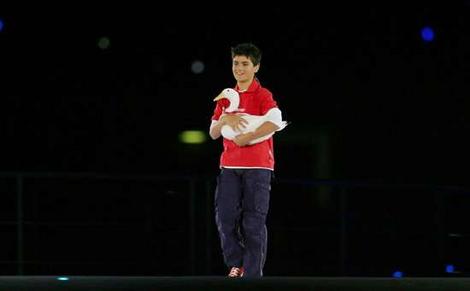
A Little Duck at the Commonwealth Games


from Wendy

A focus of the entertainment for the Opening of the Commonwealth Games in Melbourne was a small twelve-year-old boy and his pet duck, based on a poem by a Melbourne cartoonist, poet, anti-war philosopher.

A Little Duck

with a bit of luck
a duck
will come into your life
when you are not at the peak
of your great powers.
and your achievement towers
like a smoking chimney stack.
There'll be a quack
and right there at your feet
a little duck will stand.
She will take you be the hand
and lead you
like a child with no defence;
she will lead you
into wisdom, joy and innocence.
That little duck
we wish you luck.

by Michael Leunig

Perhaps some of the thousands of spectators, particularly athletes from other countries would have been puzzled by the fantasy based on the little duck, but it is an iconic feature of Michael's cartoons, to focus on innocence, fun, spirit of goodness. Michael explained that when he was 10 he was at the Melboune Olympics in 1956, a time of the cold war, a fear of Russia, Russian tanks were in the streets of Budapest. In the 10,000 metre race a Russian surged ahead and the crowd, normally in fear of anything Russian, suddenly cheered him on, politics forgotten. That is a 'duck' moment, the cartoonist said.
Pity that the rest of the spectacle was a bit over the top, rather than to be as simple as an ordinary duck!

Tuesday, March 14, 2006

Queen's visit to Melbourne

from Wendy

The Commonwealth Games opens tonight with much fanfare, probably a few kangaroos, fish, and a tram descending from the sky. It's a nice event with athletes from a host of disparate places with little in common except the expansion of the British Empire at one point in history. Fiji. Australia. Tuvalu, from Africa, Asia, the Caribbean and so on.

To have a Queen of another country as our head of state isn't a perfect situation. She does her job well, even if a tad conservative with her hats, gloves and handbags. It's good to see a woman who has dignity and doesn't put her foot wrong. But… royalty and enormous privilege by an accident of birth seems such an anachronism in the year 2006.

She has to attend many boring functions of course, listen to speeches by strangers and syncopants, shake hands with men in suits. On the other hand she is rich, very, very rich, and why should poorer countries pay huge amounts of money in entertaining and paying for her tours?

I was a little chunky royalist when I was 14 and saw a little younger Queen in Australia, then again in Fiji during a visit to Suva. The day she came to Geelong was the day Peceli and I returned ( a day early) from Fiji to find the house in rather a desperate state afther the three boys had looked after themselves for three weeks so I did not go and see Her Maj. These days I don't listen to her speeches, or cross the road to see her and I don't have much time for bling hats and gloved hands.

Of course at this point in time, we in Australia are more like the bootlaces of the USA military men! So probably the idea of a British Commonwealth is preferable after all!

Monday, March 13, 2006

Internet cafe

I have three minutes left at an internet cafe. Withdrawal symptons. Dial-up won't work because our telephone has crackle! Can't fix it for at least a day. Sobosobo, so no postings and emails today!
W.

Sunday, March 12, 2006

A Get-well Party at a Mansion


From Wendy

My friend Joy, who goes to Nabalebale village in Vanua Levu every year but lives in Geelong Australia, invited me to a party in a mansion to celebrate her husband's recovery from illness. This was yesterday from 1 pm. until nearly 8. Peceli couldn't go as he was at his Fijian church up in Melbourne.

The double storey Georgian style mansion is a surprise amidst large pines and a curved dirt road in a farming area on the way to Ocean Grove. The land is so dry at present, the grass almost white. Now this house is something to behold - a private house modelled during the 1970s on a French baronial mansion, with a glorious winding staircase, a ceiling cupola, antique furniture, large reception rooms, with gold ceiling to floor curtains and French windows. The children at the party had a great time exploring public and private areas of the house. A little six year old girl was telling me that the particular room we were in looked like it was a film set from a movie and a particular curved settee was where the lady lay down for the artist to draw! A six year old knew about Jane Austin and Matisse!

It was a lovely party though most of the guests were strangers to me except for Joy's family. There was fine food and drinks and a good time getting acquainted. But the great part was the entertainment by two guest singers, Peter and Margaret, who sang operatic arias and had magnificent strong voices - though Peter said he had nodules and should rest for six weeks. I asked Margaret could she stand on the grand staircase and sing 'I dreamt I dwelt in marble halls' and she did. Amazing. Then the two sang a love duet from 'La Boheme' halfway up the staircase and the singers acted and moved up the stairs as they sang. Peter loves to ham it up I suspect. Wonderful!

Peter has written his story in 'Finding my voice' - a narrative of a deprived childhood, a youth who sang Maria Lanza songs alone, while also singing and playing with a rock and roll band. He was discovered, sponsored to study, and has sung internationally, put out CDs of classical and operatic music. He's about 46, acts boyish or flamboyant, talks a lot, but what a voice!

But Peter, oh dear, also sang Elvis Presley, Tom Jones, Beejees, Roy Orbison covers for us, mimicking their voices and I thought, oh dear, don't copy, don't mimic, just be yourself!

I walked outside to explore the grounds with some of the little kids, to pat a foal and the mare stamped her foot at us, noticed a rose-garden, but the surrounds were just so dry this summer. The owner of the house is a charming man who lives alone in this house with probably eight bedrooms and enough space for a tribe. Isa lei, that's sad.

A bridal party at a mansion


From Wendy

My niece Megan and Sam were married at Los Vegas in January, by a celebrant dressed like Elvis Presley. The wedding reception for us relatives and their friends was held on Saturday night, the venue the Pavilion of Werribee Mansion Hotel. Megan and Sam had flown to USA, got married, and spent a week at Vatulele resort in Fiji on the return trip. She told me Votualailai but that's a village where a pig-hunter friend comes from so that wasn't the place.

The venue for the party was a renovated mansion, once a Catholic seminary with small cells and long stone corridors, now transformed for about $400 a night visitors (less if booked on the internet I'm sure, and promoted this week for visitors to the Commonwealth Games).

Werribee is renowned (by us in Geelong) as the final stage of Melbourne's sewerage system, but don't mention that to tourists of course and all the farms in Werribee area flourish. Werribee Park includes the Chirnside Mansion, the Mansion Hotel, a zoo, an Equestrian Centre and a golf course.

One proviso of the party invitation was that guests dress as brides and grooms, so what a sight it was to see about fifty women wearing white gowns with trains, sparkling jewels, much bling, pearls, veils and long trains, and even little girls dressed up. I thought of Catholic girls and their confirmations, or even novice nuns taking vows! Some of the guys wore Masonic lodge penguin suits, or Al Capone suits. My guy wore a blue bula shirt and pants and I wore my maroon hibiscus floral muumuu, once given to me by a relative in Nawaka Nadi! Two 'brides' wore black, and one looked like a sweet Guinevere. The food was gorgeous, and it was great to mingle with nieces and nephews amidst many strangers acquainted to the bridal couple through work (medical), squash, and the southern Italian side of the wedding.

The music started up with some technorati busy with the bass rhythm so that CDs now became insistent thumping and the dancing started with the ladies holding their trains and dancing rock and roll. A sight to behold. The bride wore a lovely white bared necked frock and their four children looked gorgeous as well. Ah, I wish some of the older generations - now gone - were there to behold the occasion. The ghost of Megan's Dad, my lovely brother Doug, was surely there.

Wednesday, March 08, 2006

Story from Mali Island near Labasa

From Peceli

My perception of Mali Island people, who are my relatives, are that they are kind, peace-loving, and like to fish, to sing and to sleep! When I was young we used to go to Mali every New Year for a week of celebration. My mother came from Vesi village in Mali. Close to Vesi village there is an old fort site on the top of the hill called Koi Vuanabuli and no-one goes there.

Nobody told me the exact story that I found in Jane's Oceania site about the war between the Macuata people and the Mali Islanders when Tui Macuata involved the chief of Cakaudrove and his army. This happened a long time ago of course.

---------------
In March, 1841, Tui Macuata appealed to Tui Cakau for help against the people of Mali Island, and forty large canoes with two thousand warriors set out from Somosomo. This army browsed its way around the coast like a plague of caterpillars, leaving bare gardens and months of famine where it passed. At length, after feasting and dancing in Tui Macuata's town, the combined forces of Somosomo and Macuata moved against the sugar-loaf hill of Mali, on which the stronghold was perched, with only one approach, steep, and easily defended with stones.

The operations began with an exchange of taunts, and with boasting; "each party continued for some time this kind of banter to each other till three of the Mali people ventured half-way down the path, where they stood and dared any or all to come up. All of our party that had muskets fired and killed the three, then rushed up and caught the bodies as they rolled down the path. A number of our people were wounded, and as some of them perhaps all, went rather for amusement then for revenge, there the affair ended."

After more dancing and feasting, the army returned to Somosomo; but within a few months the Mali people had turned the tables. Such campaigns were more like picnics than wars; the risks were few, the diversions many, and food was plentiful while it lasted.

The chiefs of the coastal districts seem rarely to have carried their wars to the point of complete and final victory, there were, no doubt, warriors who were anxious, from bravado or hate, to carry a beleaguered stronghold by assault and to destroy it utterly; but there were usually enough others who were luke-warm about it, to restrain them.
-----------

Nukubati a small luxury resort in Macuata


Not far from Naduri is an island, Nukubati, which is the only luxury resort in the north.

One pic is looking from Nukubati towards the mountains of Macuata, perhaps where the last stand of the Seaqaqa warriors took place, hopeless against rifles. The men had refused to pay some head tax. Some of the losers resettled in the Savusavu area.

Too expensive for the likes of me, but many people say it is lovely and certainly the people of the Friendly North want some kind of share in the tourism industry! I wonder if there is a tabu on tourists catching fish in the nearby reef!

Waitui Tabu: Marine Conservation in Macuata continued

and there's more!

This is a summary from a Conservation article I found when googling 'Macuata'.

Scoping Established “Tabu” Areas

Two weeks prior to the Fiji Islands Marine Ecoregion (FIME) "Big Win" Event in November 2005 which was held at the chiefly village Naduri, a team comprised of the qoliqoli (traditional fishing grounds) committee members and WWF Fiji staff carried out follow up consultations regarding the status of tabu areas established by communities during a consultation workshop some seven months earlier. A second team included six Peace Corps volunteers based at villages along the network of tabu areas of the I qoliqoli Cokovata and a WWF Fiji Country staff scoped the established network of tabu areas and marked its boundaries for the whole purpose of quantifying the estimated area of marine protection by the community and the set up of marker bouys for these tabu areas especially the main tabu area Talailau mangrove island, in preparation for the launch of the network of tabu (protected) areas.
The crucial role the vanua provides in the existing social system from the yasana (province) to tikina (district) to yavusa (tribe) to mataqali (clan) to tokatoka (household) level is evidently intact.

It has been a learning experience during our 3 week stay at Naduri village where the Tui Macuata (Chief of Macuata Province) resides. Seeing the commitment of a chief and his people towards protecting their mangroves, islands and coral reefs against the range of challenges from capitalism to a web of anthropogenic influences such as illegal and exploitative fishing, bad agricultural practices and unmanaged industrial development has been inspiring. A commitment envisioned by the chief and his communities: Siga Damu a Vanua encapsulates the promise of a new day as the hues of a sunset paints the sky-a war cry in tradition to rise up to the challenge of establishment of a network of tabu areas, the first in Fiji at such a scale.

Talailau: An island of special significance

This was island highlighted during the launch of the network of tabu areas in Macuata. Prior to the placement of the 4 marker bouys demarcating the boundaries of the tabu area of 19.24 sq.km around Talailau, it took several boat trips and a scope around the reefs fringing the island to realize the nature of the tabu area earmarked to be the showcase of the MPA network in preparation to be launched. In addition to its ecological importance, this mangrove island has special cultural significance and regarded as the fish basket of the province, which fish caught for cultural ceremonies are taken from Talailau’s reefs. It is situated 3km off the main coastline of Macuata, about a half hours punt ride weaving by the many mangrove islands which dot the coastline.

Kia: an island on the Great Sea Reef

Towards the upper end of the notch on the band of barrier reef which make up the Great Sea Reef, lies Kia with an island area of 2 sq.km. During the scoping exercise carried out for the mapping of the tabu areas and the placement of marker buoys throughout the Macuata Tabu Area Network, Kia Island has made an impression. At such far flung distance of 24km from the mainland Vanua Levu, by first glance, Kia seems lost out in the ocean, an arid place devoid of lush vegetation surrounded by deep blue waters.

According to its profile as a tabu area established by community, the breaks in the barrier reef are regarded as spawning areas for much of the local fisheries and important commercial fish species such as the endangered humphead wrasse. This is one of the few undiscovered places for diving in the Fiji group which boasts high coral cover and large marine fauna.

These marine protected areas in Macuata were the first of a series of MPAs that will form one of the world’s largest networks of underwater sanctuaries.

Waitui Tabu: Marine Conservation in Macuata

from Wendy

Two stories in the Fiji Sun this week negatively reported an incident in Naduri village when the chief and people confiscated a fisherman's boat, his catch and divided the fish between the people, demanded $2000 for the recovery of his boat, etc. Now on first reading this, I was shocked by the reaction of the Naduri people... but then there is always more to a story. Tui Macuata is a conservationist and is passionate about marine conservation in Macuata!


From Island Business - last year

International and national conservationists were delighted with the move by Macuata province, led by its paramount chief, Ratu Aisea Katonivere. Not only has his 'waitui tabu' boosted government's commitment, it has also led to the protection of the world's third longest barrier reef known as the Great Sea Reef.

It has an area of around 202,700 square kilometres and the reef is 200 kilometres in length. It is located in northern Macuata waters. According to WWF's Fiji office, a recent survey at Great Sea Reef showed that it is home to 55% of all the known coral reef fish species in Fiji, 74% of all the known coral species, 44% of the known marine flora and 44% of Fiji's endemic reef fish species.

In hosting WWF executives last month, Katonivere said the realisation that they were the custodians of one of the world's largest barrier reefs prompted him to encourage his people to support the concept of marine conservation. He said this important resource needed to be preserved for future generations of Macuata.

“What is my role as the paramount chief of Macuata? What will I leave behind when I go to meet my Creator,” he told this magazine. “Now I can go and marvel to the Lord about what I have done, in that I have created a source of livelihood, sustenance for my generation and their generations.”

Until November, the fishing taboo in Macuata's marine protected areas had been in force for only five months. But Katonivere said his people had already begun to see a marked change in the size of their marine catches.“In the past five months, we have seen God's miracle. Fish that were not seen near our shores have now been seen. Not only fish, but the same goes for seashells and mussels. “I wonder what will happen in five years' time? To me this has created a hope for an alternative source of livelihood for my people.”

Katonivere's sterling leadership has not gone unnoticed. A member of Fiji's influential council of chiefs says Macuata's leadership in marine protected areas has prompted the council to consider adopting the concept in the remaining provinces. “What Macuata has done has greatly encouraged the other provinces,” council member Ratu Ratavo Lalabalavu told ISLANDS BUSINESS. “From what we have seen, most of us are in favour of adopting marine protected areas in our provinces as this will help in providing a sustained source of livelihood for our people.”

Tuesday, March 07, 2006

Visit to Paul Jaduram at Delailabasa


From Peceli

Paul Jaduram the former Mayer of Labasa invited me his new home on the hill of Delailabasa where most the well-off businessmen built their houses. Standing on the top verandah of Paul's house in Delailabasa after we had a cup of tea and chat I looked towards the township area. These elite houses overlook streets of small houses in a housing development and the town. Tula and Paul Jaduram had built their houses on the best location in Labasa, much higher than the township area which sometimes floods and is low-lying. The houses at Delailabasa mostly cost more than $300,000 or even a million dollars.

When I was a child the grandfather of Tula and Paul, Jagnath, was the first Indian who had a big business in Labasa which was called Nasea then. He had a shop. Then they built the picture theatre and a line of shops in the town. Jagnath's daughter was Paul and Tula's mother. They became one of the wealthiest families in Labasa and Tula is the owner of the Takia Hotel in town, and Paul owns Centrepoint. At one stage Paul owned the tourist resort of Nukubati, down the coast from Labasa.

It is amazing to us Fijians how families like this have worked so hard in Labasa to develop their wealth and status. Other Indian families I knew were Tamana Gurbachan Singh who had a big shop in the town and then a son became a mayor and he has a hotel close to the hospital and he owned many other shops in Suva and Lautoka.

Monday, March 06, 2006

recommend two more Fiji blogs

I found an informative site from Suva, the Pacific Agricultural Genetic Resources Network, from Luigi Guarino at the South Pacific Commission. Up to date information about various South Pacific islands trees, plants, etc. Thanks you to Vakaivosavosa who tipped us off about papgren. Some serious good stuff in Ms Vakaivosavosa's site also. Vina'a va'alevu!

Meanwhile we seem to be getting away from our original intent to focus on the sunny dry land of Babasiga and Labasa area, so loloma to the girls and women at the Labasa Women's Crisis Centre, especially for tomorrow, International Women's Day and may the Macuata women continue to be brave and strong!

Sunday, March 05, 2006

Sarita's Dance

from Wendy
Peceli is too busy with people to even look at the site today So here's an offering from something I wrote - a story set in Suva about neighbours. The idea came, though, from a concert by students of Grammar school several years ago when a friend Nina was the drama teacher.

The story of Sarita's syncopated dance four years earlier was a local legend. As she needed to rehearse for cultural events, she had practised on the back balcony with Krishna's friend Datta playing the tabla. One evening Sarita was into a full dress rehearsal, her gentle hands trembling, her head and torso twisting, the satin and sequins of her costume shimmering. Across the gully, one of the Fijian lads had a medium sized wooden lali on his back verandah. He started beating in time to Sarita's steps and the tabla. When Datta's fingers paused, Sarita continued swaying to the youth's drumbeat, now with a syncopated rhythm. The lad paused, Sarita performed a few steps, then both drummers alternated, resulting in an ebb and flow of rhythms across the gully.

Jyoti, fifteen then, had been entranced by the gift of music and dance, by her mother's grace and by the youth's energetic beating. When the dance ended and the ringing sound of the drums faded, Krishna, Datta, Sarita, Janki and Jyoti had collapsed in a heap of laughter. The Fijian lad waved and beamed with pleasure. Way the world ought to be, hey? Jyoti knew that contact between people of different cultures was often a brief hullo then go on your way. Occasionally there was kindness and respect. Sometimes though, there was hostility and fear.

The story had been used in the eulogy at Sarita's funeral a few months later, a symbol of the possibilities of art to transform, to make a difference.

Saturday, March 04, 2006

Eagles and the Nullabor Plain


From Wendy

This morning our interim minister, Richard Franklin, spoke to us of the desert experience of Jesus, amidst the wild animals - metaphorically I guess.

Richard told us of his own experiences in exploring parts of the Australian landscape, of seeing hundreds of wedge-tailed eagles when his family drove across the inhospitable Nullabor plain from South Australian into Western Australia. Recently we have spent time with some young people who are encountering a loss of identity, a great fracturing in relationships, so I wrote tentatively a few lines.

There is a huge nothingness
of the Nullabor experience,
a desert, dry, raw, without comfort.
We have all been there
and need to be.

Then the eagle soars,
strong with a purpose,
lifts with the air
and we know there is more
than this emptiness,
this dry spirit -
part of the journey.

The pic by Richard Woldendorp is entitled 'Where the Great Australian Bight and theNullabor Plain meet'.

Friday, March 03, 2006

The kava is flowing


from Wendy

I came home from a meeting to find Peceli with four young Fiji guys playing Lock cards and the kava bowl is full.They had spent three hours packing a large container with computers, beds, etc. bound for Fiji. A tape is playing sentimental songs of the islands. Yaqona in Melbourne costs about $50 a kilo, in Nadi it is $20.

Travellers are allowed to bring back 2 kilos, but only in powder form, not in the big bundles you buy in the Fiji markets. I think kava-drinking is banned in some parts of Australia - maybe Northern Territory. The kava bowl is brought out about three times a week in this household. Is that too much?

Pacific Harbour, a favourite place

from Wendy

Before it was a place for day picnics or to drive past, but now my three-year-old grand-daughter lives there, it is a special place. My youngest son and his family have a lovely villa there. Pacific Harbour is a place I am sure for future development. Even an internet cafe! The Pearl is up and running and the Lagoon, which seems more Italian than Fijian, often houses actors and movie-making crew - Anaconda etc.

Deuba was just a modest hotel at first, built for the making of a movie about sixty years ago. In the 1970s there was a major development of fine looking villas - for expatriates, Fiji professional people, and time-share or rental. Most of the Google sites seem to be for selling houses there!

Our local Rotary clubs financed and built a small half-way house near the river for the people of nearby Yanuca island when they come and go and the volunteers got a bit of flak from some of the elistist neighbours!

In today's Fiji Times there is an item about the recent renovation of the Arts Centre.

Arts Village expects a business boom
Saturday, March 04, 2006

THE Arts Village in Pacific Harbour expects to enjoy a resurgence in business as a result of several capital projects about to open by the end of this month.

Village operations manager Jone Navuku said the new ventures in the area to be launched included a backpacker resort with a 70-bed capacity, an Internet cafe and a convention centre.

"Since last year, we have been growing steadily and many tourists are coming in everyday to enjoy the shows and the beautiful surroundings of this village," he said.

The Arts Village was formerly a cultural centre before Australian businessman Eric Roberts bought the property two years ago and renovated the centre as a tourist attraction.

The Arts Village dance group performs traditional games, meke and enactment of tribal wars daily for tourists and guests.

"Sometimes we perform twice in a day if there is an influx of visitors," Jale Mareau, the leader of the dance group said.

The Arts Village employs 90 people.

That is expected to increase with the opening of the new ventures.

"The staff here know how to do pottery, plaiting of mats and other traditional gifts made from pandanus leaves and traditional stuff," Mr Navuku said.

Thursday, March 02, 2006

Stoned in Eastern Park


from Wendy

Stoned in East Geelong

A dotted line of stones is taking shape 2 k from us. Andrew Rogers, of Melbourne, yesterday claimed credit for embarking on the largest contemporary art installation in the world. Who is Rogers? Oh-oh, he's a sculptor who never went to art school and his Mum comes from Geelong.

Eastern Park hillside is being transformed by white stones. A bird? A fish? No, it's Superglyph! A geoglyph is an image marked out with stones or boulders, which can be fully appreciated only when they are viewed from a plane or helicopter or spaceship.

The geoglyph at Eastern Park has been made with white limestone from the Fyansford quarry with each stone about the size of a twelve-year-old. There are hundreds of them. The idea is to celebrate the Commonwealth Games with art. I wonder why? They say it can be viewed from outer space, but who's going there? I am sure the locals are a bit mystified by the excitement with these stones on the hillside overlooking our bay. How long will the stones be there I wonder. Will they eventually look as good as two other geoglyphs pictured here? It actually is shaped liked the one in Israel and called 'Rhythm of Life'.

The Queen's Baton


from Peceli

Queen's Baton comes to Geelong, our town.

We are looking forward to the Commonwealth Games and to see the Fiji teams coming to Melbourne. In our local paper there is a write-up today about Fiji, including a pic of Serevi and the rugby players from Fiji.

The baton comes to our town today. The first Queen's Baton was created for a relay to celebrate the Cardiff 1958 commonwealth Games in Wales. At present it is going around Australia on the last lap and today it will reach the City of Geelong. Thee are 71 countries in the Commonwealth, the Queen as head. The 71 lights on the baton indicate the 71 nations. At Eastern Beach and the Waterfront there will be a huge party which includes the arrival of Karak, the mascot black cockatoo!

To start the official welcome there will be an Aboriginal welcome by members of the Wathaurong tribe. Our city is at the forefront of celebrating a multicultural Australia and the Aboriginal flag has been flying at our waterfront for a few years now.

Wednesday, March 01, 2006

Tabu and Fijian hair


From Wendy

Last week a group of local businessmen asked Peceli to join in a project to raise $5000 for charity to assist cancer research or the local hospital. The project was of course for them all to have a major haircut and become totally bald! Obviously they do not know about tabu and Fijian hair.

Now it is tabu to touch the hair of a Fijian for a start, so we discussed the idea and resolved to say no. The businessmen were surprised and just couldn't understand that 'tradition' was the excuse for not joining in!

Of course the young Fijian guys these days certainly have a variety of styles, 1st cut, short side and full on top etc. and even including going bald - middle-aged men as well, including turtle-oil loving Speight!

Young Fijian women today sometimes have short hair cuts, or long braids with beads, or colours! In a recent speech by a woman from the Ministry of Women in Fiji however there was a strong statement that Fijian women should remember to keep their hair in the traditional style and not to cut it short, not to wear shorts or pants but to wear a dress and long sulu!

In the olden days, hair styles were a major concern, bleached, straightened, multi-coloured, dread-locks. Here are a few pics taken from Jane Resture's website of old photos.

Karak the Commonwealth Games mascot


From Wendy, and adapted from notes from Healesville Sanctuary.

Karak is the mascot for the Commonwealth Games in Melbourne, commencing in two weeks time.

Playful. Loud. Friendly. Energetic. Handsome. Cheeky. Endangered. That's Karak, the South-eastern Red-tailed Black Cockatoo who is the Official Mascot of the Melbourne 2006 Commonwealth Games (15-26 March 2006). The Karak is named after its distinctive bird-call. The red gum is its native habitat and the bird feeds on brown stringybark and buloke trees. Coming from the Little Desert area in Victoria's Wimmera and Western Victoria, Karak is a bit of the Aussie larrikin, typifying the Games spirit of friendship through his gregarious nature.

This bird is actually in danger of extinction with only about a thousand left. The death of gum trees on unprotected land, intensive farming and the removal of potential nest trees for firewood all contribute to the loss of Karak's nesting habitat. Natural feeding grounds are also disappearing through extensive land clearing.