Thursday, August 31, 2006

from James Siers 'Fiji in Colour' 1969


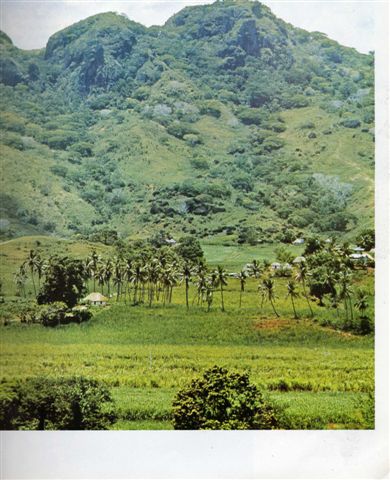
A book I found for $1 in an op-shop, James Siers 'Fiji in Colour' of 1969, has several photographs taken in the Labasa area. Here is one of the Three Sisters mountains.


Labasa town in the 60s, cane-fields from the air, and the Fiji Airways Heron at Savusavu on the south side of Vanua Levu. The pictures below are of the Commissioner Northern of that time, Mr Parkes, and his family looking at the historical stones of Wasavulu which require an explanation which I will write about later, and fishermen at the Labasa market.


W.

some questions raised at the Bau Conference

No doubt when Peceli sets foot in Geelong again in a couple of days, we can have some real stories of the Bau Conference. He was fortunate to visit Viwa Island yesterday where John Hunt, the missionary once lived and I hope the photographs come out!
Here are topics raised at the conference in the Fiji newspapers though the slant they gave is rather limited.
I. Next conference will be in Macuata - hoorah for babasiga land! and the choir competition in Furnival Park, Suva, so how can a member of conference who sings in a choir straddle the distance between Macuata and Suva?
2. Corporal punishment in schools and homes is okay and should not be banned. Well....
3. Gay rights as in the Fiji Constitution should be reconsidered. Hmmm.
4. The move to increase the financial levy did not get through, and half of the circuits are behind in their financial commitments.
5. A research group is to be established regarding music. Hoorah!

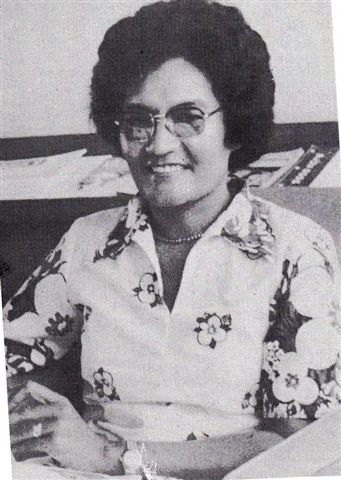
6. The vote for a new vice-president was interesting. Lorini Tevi was nominated but didn't get the numbers. Now that would have been marvellous. She is a smart, articulate woman who has worked in Geneva at the World Council of Churches for many years, returned to Fiji and certainly she would be better than the men! Here's a photo of Lorini in earlier days. Isa lei, Lorini was recently widowed.
W.

Picasso's Weeping Woman - stare, or walk on by?


Picasso's Weeping Woman and other stories

Would you stare at a woman in the street who looked like Picasso's 'Weeping Woman'?

This week I read a blog from a young American woman married to a boy from Bahrain. They live in his country. I presume she is young, attractive, dresses in a western fashion but modestly. in her blog Hypnotic Verses, she wrote a rant about people staring at her, people jumping the queue, and when in a conversation people moved away and ignored her.

Moody Minstrel, who lives in Japan responded in his blog with his story of being stared at because he is a foreigner, and at one time he was speaking in Japanese to a woman, and she answered 'Me no speak English' and she moved away.

This made me think about people who look different, and how they are treated. It reminds me that in Fiji we stereotype people a lot and certainly categorise people by ethnicity far too much. I guess people sometimes stare when they see Peceli and me, a Fijian with a vavalagi wife.

Here are some other examples.

Walking down the street, suddenly I notice a very short person, what in Fiji is called 'lekapai' - a dwarf. Do we look away, ignore the person, or stare. Out of curiousity we tend to look again.


Like when I met a woman who reminded me of the guy in the movie 'Roxanne', I could not help but keep looking back at her face. Are we rude, or just curious?


This week I was with a group of women and one lady in the group gave a talk on her disability, a woman who happened to be of Sri Lankan descent. She requires a wheelchair and has difficulty speaking, yet I could understand her by listening intently. She joked a lot, but underneath I could see that she really wanted to convey to us a message about how we could better relate to people with disabilities. 'Don't lean on my chair, don't pat me on the head or shoulder. Maybe say, May I help you?' but don't assume you have to. Don't say, You are brave dear. Don’t stand above me so that I have to look up all the time. Try and find my level.’

On the other hand, it is easy to not even talk with a person with speech difficulties, easier to move away. Let others do it.

I was sitting near a shy man and a talkative man it the Mood Support Group yesterday when I was helping them with their creative writing. We were talking about what happened in the TV show, 'Australian Idol' when a judge told a girl who had not sung well 'You're a joke! You know it! Everyone knows it!' This was on live TV to millions of people. She had dressed as a rocker but didn't deliver, had trouble keeping up with the band. But….The men in the writing group were angry and adamant that this was a terrible thing to say to a young girl. It's possible to give positive feedback without nastiness we decided.

A few weeks ago I met young young Muslim woman with long blond hair, who dressed in jeans and a shirt. She told us that she used to wear the headscarf but one day a drunk holding a beer bottle alarmed her and her daughter with his threats. She decided then to try to look just like everyone else in the community. Unfortunately in Australia at present, even our PM is adding fuel to the prejudices as he talks about 'our way of life' - whatever that may mean!

We can't undo what we say to people. Perhaps that's why sometimes we just keep quiet or turn away from people who look different. But we have to take a stand with people who look different, be sensitive and friendly without being patronising. It's not easy. Stare... or walk on by?
W.

Wednesday, August 30, 2006

Which one is Fiji's Police Commissioner?


Which one is Fiji's Police Commissioner?
Miss Pennyhoney

Apparently it's Blog Day! Isn't it always?

Now I do not like being told what to do, but okay, I will participate in this Blog Day thing, and find 5 new blogs that I find interesting. Don’t be offended if I’ve left you out! There are others that I read! And of course we have to promote our second blog-site geelong visual diary!

Not in any order:
M and J includes stories from a Fiji girl living in Bahrain.


Pandamonium from Japan who has lived in various Pacific countries so lots of good stories and pictures.


Julie’s Pictures from England – drawings, paintings, family life

Karen’s pics from USA –drawings and paintings


Life and Death - from Singapore, a very new site, a bit of a mystery man with stunning photographs from Asia and the Pacific.

Promoting Suva – for information for locals and tourists to Fiji’s main city.

And a website Tribewanted has the Fiji blog about an eco-tourism set-up on Vorovoro Island, Fiji.

And a website Jane Resture – with oodles of information and pictures from many South Pacific cultures. The site I've linked is her Fiji site.

Okay, that’s not five! I told you I don’t like people bossing me around! I'll tweak this posting later, maybe with some pics, but I have to go and speak to a writing group this morning.
W.
The BlogDay tag : http://technorati.com/tag/BlogDay2006 and a link to BlogDay web site http://www.blogday.org

Tuesday, August 29, 2006

Fiji website in Townsville

This website can give you some of the Fiji radio stations as well as news from the Fjians from Burebasaga who live in the Townsville, Australia.

Burebasaga Online. Welcome to Burebasaga Online. This site serves as an information centre for people of the provinces of Rewa Province,including Namosi, Nadroga, Serua, who live in Australia.

Musical instruments and the lotu

This is my pet topic and has been for most of my life - how to energise Christian church worship with appropriate, relevant, exciting music and it has been an uphill battle. One evening -in Geelong - I joked to an elderly lady - 'They should put a bomb under the pipe organ' and a horrified look crossed her face! I will write more about music in Geelong in our other blog geelong-visual-diary.

Okay I'm not going to give you a thesis about Fijian church music - though I've written papers on it, but the subject has risen again at the Methodist Conference in Bau. It's because traditional four-part harmony, unaccompanied, has been the norm since the 1890s, though earlier the same (psalm/story/lament/Christian narrative) and taro (questions and answers) were in the vucu style of chant.

In the Fiji Times today:
Church to look at role of musicJONA BOLA
Wednesday, August 30, 2006

A Methodist research group will be established to research the use of musical instruments in the Bible and it's relevance to the Methodist Church of Fiji and Rotuma. The decision was made after questions were raised on whether there was a need for the church to use musical instruments during church services at the annual Methodist Church conference in the chiefly island of Bau.

A delegate at the meeting said youths were being greatly influenced to use musical instruments during worship and that the issue should be looked at from all perspectives.

Delegates had contradicting ideas about the issue….etc.
--

The subject can be volatile because older people may not like noisy bands, and young people often do. Some of the American-style of churches in Fiji are attracting many people with their energy, musical styles, etc.

Of course the Methodist Church in Fiji is not just ethnic Fijians and in the Indian Division musical instruments are used - e.g. organ/piano, guitar, etc. as well as the harmonium, dhola, tabla, and other Indian percussion instruments. Here is a picture of a Fijian young man singing qawali style with a group of youth in Labasa a few years ago. I would like to see the day when more Fijians sing bhajan and qawali style of music.
W.

Cane cutting - sisters are doing it for themselves


Though it's not usual, women can join in sugar cane cutting gangs such as these women who go up to Labasa every year for the cutting season. The story is from the Fiji Times. Sisters are doin’ it for themselves!
W.

Cane cutting in Labasa
SEEMA SHARMA
Tuesday, August 29, 2006

Friends for life... Dimele Valewale, Maria Joana, Amelia Verevakacuku and Filomena Matemaitoga of the Vanuavou gang. A group of women from Cakaudrove and Taveuni have developed their friendship over the years, harvesting cane together and living in the same house for at least six months every crushing season. They attract a lot of attention while harvesting cane in the Cawaira and Soasoa areas in Labasa because their gang is the liveliest and is dominated by women. Known as the Vanuavou gang they make sure that their target is met each day before they return home every evening.

They said their friendship had developed over the years because they have braved the scorching heat and the rain together in the cane fields.During non-harvesting season they return to their villages and concentrate on their coconut plantations. Ms Valewale said at the end of the harvesting season, they do a bit of shopping and return home to collect coconuts.

The women were from Saqani, Bouma in Taveuni, Wainika in Cakaudrove and Natua in the Wailevu west coast. They said although life was a struggle, they were happy to have work and make some money.

Monday, August 28, 2006

Weighty matters at the Conference


A reporter from the Fiji Sun writes: The Wainibuka Methodist division killed three cows and three pigs to feed the 800 Methodist Conference delegates lunch in Bau yesterday. Leading the 200 women from the division Rejieli Seruvakula said they started preparing the food from Sunday night...

Meanwhile a group of doctors from Fiji are attending an Obesity Conference in Geelong this week...
W.

A street in Suva


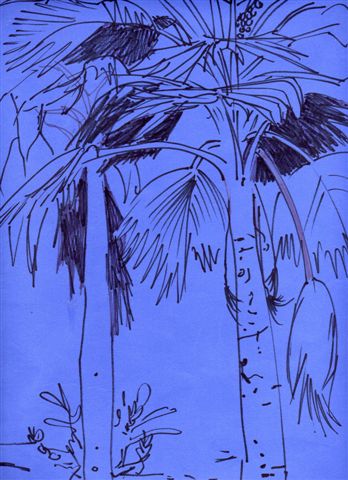
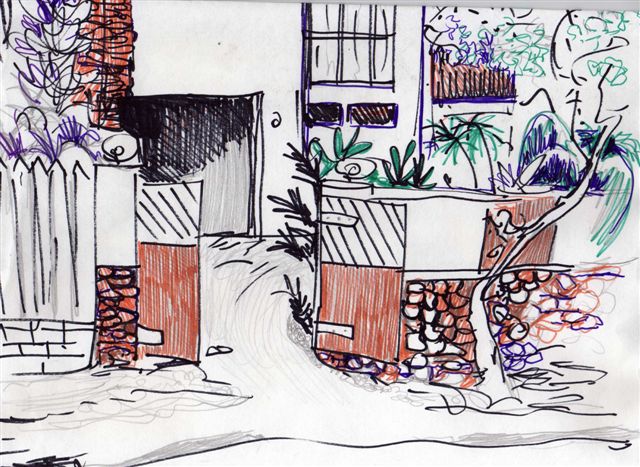
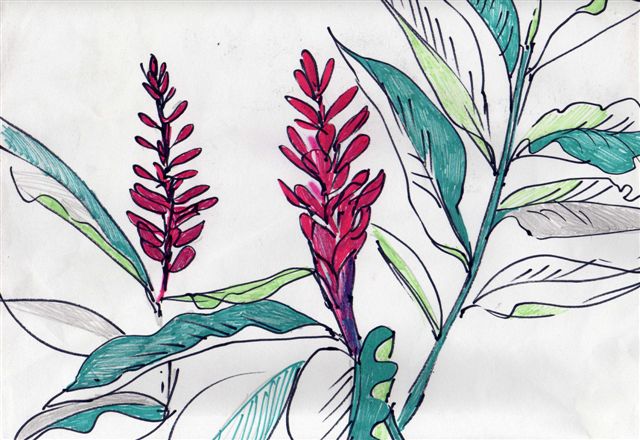
Straggly fan palms and the occupant of the house said, 'Don't draw those shabby trees,' but I like shabby trees. The house looked inviting with an open gate, not like most of the neighbours with their locks and alarms and fierce dogs. The red ginger plants grow everywhere.
W.

Sunday, August 27, 2006

Do Fiji Methodists drink alcohol?


When Akuila Yabaki was re-instated into the Fiji Methodist Church after his 'lapse' a few years ago in drinking alcohol.

The Fiji Sun wrote this at the weekend:

This week Reverend Akuila Yabaki was reinstated as a Methodist church minister after he was excommunicated in 2001 for drinking alcohol. The rules of the Methodist church clearly states that any minister found drinking alcohol will be defrocked and banned from the church. Reverend Yabaki had always maintained that he drank to socialise, not to get drunk. If drinking alcohol moderately by ministers was not allowed shouldn’t the same be said for drinking grog excessively? That’s exactly what is happening at Ratu Cakobau park.
----------
This connection between Methodism and abstaining from drinking beer, wine, etc. probably developed because of drunkeness and to see a drunk man or woman or teenager for that matter isn't a pleasant sight. Perhaps it's also about the use of money when there's nothing left for the family groceries. Ministers should set an example toa the flock I guess.


But there is no ban on drinking kava - though it is not alcoholic - it also has certain effects - laziness the next morning, it costs money, it separates the drinkers from their kids who might be running wild. Members of the Assembly of God churches, sometimes called lotu tagitagi - 'crying church' abstain from kava.


I wonder if John Wesley had a glass of red, red wine with his dinner?

Spell checked - Bread More!

I noticed a story in today's Fiji Times and the spell checker did a great job with a name! Bread or cakes? Let them have cakes!
W.

Expert sets path to reform
Monday, August 28, 2006

AN Australian technical consultant will arrive in the country in two weeks to set up a unit for comprehensive reform of the civil service.

Public Service Commission chairman Stuart Huggett said this would be the initial stage of a comprehensive reform process involving wide-ranging consultation.

Mr Huggett said the arrival of consultant Bread More would be part of the first phase of a five-phase reform plan to revamp the civil service.
etc.
--

Friday, August 25, 2006

Vorovoro and Fiji Time


Things are hotting up on Vorovoro and despite the travellers' references to Fiji Time and waiting a few hours here and there, it really is going quickly. A barge has moved timber ready for the big bure with guys from Matailabasa - a village of Mali people down near where the Indian Snake temple stands. A St John's Ambulance worker, Va, had spent two days on Vorovoro teaching a First Aid course and kits are being organised for land and boat. The toilets are going up. A rep from the Fiji Visitors Bureau has visited. September 1st is the 'Arrival Day' and so far so good.

People refer to Fiji Time as casual, very late, very 'no worries mate' but I am pleased that the tribewanted guys are doing well so far.

There are podcasts on the site including a discussion with Va the St John's Ambulance worker and another with a guy from the Fiji Visitors Bureau in Suva. I wonder who is paying for their airfares as it's about $360 return - Suva-Labasa-Suva.

I've pinched the photos from the Fiji blog on the tribewanted website.
W.

Thursday, August 24, 2006

Amazing Grace Reuben


Amazing Grace Reuben

Grace Reuben is a candidate to become a Methodist minister, alongside over thirty candidates which includes six other women. I’m all for women as ministers and this has been customary in the Australian Uniting Church for many years. In Fiji women usually become deaconesses. Grace is married to Michael, and she has been a local pastor already. Her father is Rev. Lucas.

The Deaconess Order in the Methodist Church in Fiji was initiated and developed by Pauline Campbell, a missionary from Australia, and has had hundreds of excellent young woman from various ethnic communities in Fiji. Pauline worked for many years in Fiji and loved the people.

There have been very few female ministers in Fiji. Rev Meraia Siri, who worked for a few years in Labasa amongst the Indian community, is a beautiful and compassionate person. We first met Meraia as a little girl in Rakiraki when her father Ari Siri worked in the sugar industry and we had Sunday school in their bure. Ari came from a family in Navua. I used to visit Meraia each time we went to Labasa and we would sit down to a meal of dhal and rice and coconut pie as she told me stories to get me up to date with news.

I remember Loloma Tukai, one of those early deaconesses who worked in the Ba-Ra Indian Division, and later went to Vanuatu, married a pastor there. And by a wonderful coincidence, she is now in Geelong! I was so amazed to have a phone call from Loloma a few days ago. We had barely met since the time she stayed with us for three months in Rakiraki!

By the way, Mrs Reuben is from Labasa and has been a lay pastor for the past ten years.

Akuila Yabaki a breath of fresh air


I was pleased to read, though the journalist in the Fiji Sun, Kelera Serelini, over-explained the former misdeamours too much so that it read as comedy, that Rev Akuila Yabaki has been accepted back as a talatala in the Methodist Church in Fiji. He is an intelligent man with recognition outside Fiji as a compassionate and passionate advocate for democracy in Fiji, and in so doing has upset many conservative, traditional people in the church and society. He provoked and stirred and persisted. He is a breath of fresh air in the church!
The picture of Peceli and Akuila was taken several years ago at a World Council of Churches conference in Canberra.
W.

Wednesday, August 23, 2006

pictures of Bau island


I found two photos from a teivovo - rugby site - which were taken about four years ago and an old drawing of Bau.
W.

Found a site with excellent photos

By accident - searching google for 'Bau Island' I came across a very beautiful site with superb photos, including some taken in Fiji, and some great ones of banyan trees. Check it out. Vapham.
W.

Tuesday, August 22, 2006

A nurse from Labasa hospital told me a story

A nurse told me what happened to her one day and I have adapted it into the following short story.
W.
Nanumi Siga

I was going off duty when the matron spoke to me in her usual rattling pace. 'Nanumi, I'm going away to Suva for two days. Can you check on my flat? There's some wild lads in the town who break in. I don't want my things disturbed. You can sleep there.'

'Thanks.' After our crowded quarters with six of us falling over one another I decided that this would give me some restful space so I took the key! 'I'll spend the weekend there as I'm off duty too.'

The two bedroom flat was one of those typical male-designed spaces in blunt concrete. I asked Pinky, an Indo-Fijian nurse, if she would sleep over there too.
It was a windy night and I was restless. The weather forecaster had warned of a cyclone 500 k west of us. We would be in for a blow within twenty-four hours unless the cyclone swung away over the sea. I'm used to cyclones because I come from a small island, not this sugarcane town.

I felt a kind of paralysis that saps the body when you're really asleep. My bed was directly under a large window. I saw two large smudges emerging from a dark grove of banyan trees. Two figures floated over the fields, pushing the stalks aside as she came nearer. They were two tall women with wild hair, in shabby clothes; not the neat cottons and smooth fabrics we wear today, but bark-cloth wrapping. White and orange streamers waved from their arms and waists showing their chiefly status.
One beckoned to me and smiled. She had bright blue eyes. The other glared at me with fierce dark eyes. When her arms reached out to touch me my breath just stopped, so enormous was my fear.

I threw off the blanket and ran to the other bedroom. 'Pinky! There are two ghosts outside!'

She murmured, 'Go back to sleep. It's only a bad dream.'

The figures outside dissolved and all I saw was a field of sugarcane and the wind thrashing on the window.

I lay down again but my mind drifted back to my island to find a calm centre by focussing on a pleasant memory. However all I could imagine was a dark brown sludge in our island lake. Instead of seeing children playing on the beach and the aunts singing as they plaited mats, I saw a mystery lake, a place we were banned from visiting. When I looked closer, a large writhing snake was surrounded by hundreds of smaller wriggling snakes. Our ancestor god was telling me to pick up one and touch it but I could not!

My name Nanumi means 'to remember.' When I asked my father where my name came from, he had told me that his grandfather who often sat in a rocking chair like some of the vavalagi people do, told him to name the next child, Nanumi Siga, meaning 'to remember the god Siga' because the Fijian gods have been forgotten.

I could not sleep, aware that out there, near the cane fields were the two goddesses, who had carried the large stones across the mountains to a place nearby.
The matron's flat was on the edge of a deep valley of farms but beyond there was a sacred grove, a place where no-one ever intruded except children looking for coconuts or mangoes to knock down, or some curious tourists who should not go there either. The Land Tribunal was in the middle of a legal argument about clearing this area for more cane farms. The chief was resisting such change. 'It was a sacred place, where gods once walked,' he'd said. There were photos in the papers and an American man had written a book about it. There seven large grey stones, two upright, but five lying prone in the grass but in a rectangular formation with smaller stones and platforms. A temple once stood there A men's place, but their gods had been two women.

I'd walked near that site twice when women in the village were in labour and refused to come into the hospital to deliver.

I'd heard some of the stories of the two goddesses from patients in the Psych ward. There were other stories of two chiefly sisters, one about the girl who turned into a bat at Macuata-i-wai Island. These two sisters were chased away from their mountain village by their angry father over a matter of uncooked yams. Some of our stories get mixed up and are told differently.

Now I have seen for myself the two goddesses of Wasavulu, but Pinky did not believe me.

At dawn, I threw my clothes into my bag and fled back to the safety of the crowded nurses' quarters as Pinky walked with me. I wondered then if she ever dreamt of or saw with her own eyes, Krishna, Lakshmi or Rama.

She answered, 'No, I'm a modern girl. I've left all that behind!'

But I don't think we ever leave all of that behind. It's still with us, like a strange wind that sometmes moves in a wave over the canefields.
Hibiscus Festival girls

I don't know if the writer of this letter to the editor in the Fiji Times this week is trying to do 'blonde' kind of jokes, as he sounds serious towards the end of the letter, but I think it's great.
W.
Hibiscus humour
I refer to your Davui Column (FT 21/8) concerning a certain Hibiscus contestant answering in English when spoken to in Fijian.

In the days of old, there were many stories of contestants who made people sit up and think.

A few years ago a contestant was asked by the host of the evening, "What airline flies twice weekly to Japan?" She answered in the form of a question Air Fiji? In another festival a contestant was asked what her favourite dish was, her answer was pyrex dish. That will take some chewing. And in another contest a contestant was asked why she was still in her casual clothes and her sponsor must have given her money to buy new wardrobe. She answered brightly, saying, "Oh yes, I bought a new wardrobe from Courts."

I feel when application forms are sent out, people who respond should undergo an IQ test and pass it before entering the contest. Otherwise the quality of the festival will be brought down low. Remember winners would represent Fiji in other festivals in the Pacific and even world. Just imagine if one of the girls were asked to say something in her native tongue and couldn't say anything or asked who George W Bush was and didn't know.

Allen Lockington
Lautoka

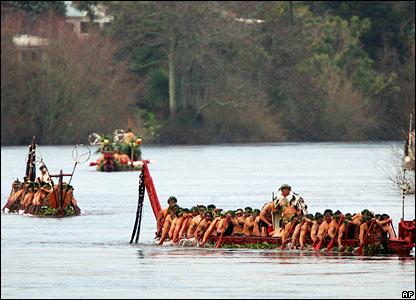
Farewell to Maori Queen in New Zealand


Maori Queen’s Funeral At Turangawaiwai

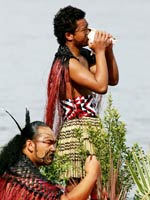
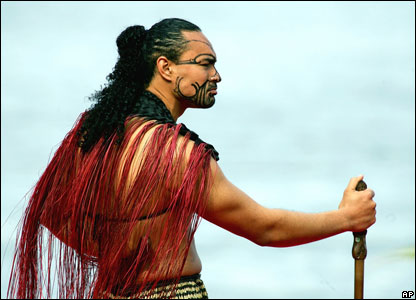
WELLINGTON (Reuters) — Tens of thousands of New Zealanders gathered to bury the Maori queen, one of the country’s most respected indigenous leaders, and celebrate the inauguration of her son as her successor. The tribal home of Dame Te Atairangikaahu, was overflowing as Maori of many tribes, New Zealand and Pacific political leaders, and many others of different races attended her funeral ceremony. Dame Te Atairangikaahu ONZ, DBE, (23 July 1931 – 15 August 2006) was the Māori Queen for 40 years.
--
Peceli and I were briefly in New Zealand one time and what a lovely place it is. We drove to Hamilton following the Waikato River. I think that Pacific people from various Island states feel warm towards the Maori people. We have many Maori friends here in Geelong and sometimes attend their weddings and parties and meet up with them at rugby of course.
W.