Wednesday, March 07, 2007

Some Anglican history in Labasa from the 40s


from w
Today I have delved into Google to see if there are archival stories of the Anglican church in Labasa and I found this one. I'm interested because at present we are concerned that St Mary's Hostel has been condemned by the Labasa Council though of course it is important to keep the hostel - which houses sixty girls - going. Also, the area on which some of the Anglicans now have a school, housing etc. is where Peceli lived as a small child, low-lying land not far from the Labasa river, and flood-prone.

POLYNESIA PATCHWORK - THE TALE OF A PACIFIC DIOCESE
BY C. W. WHONSBON ASTON
Published for the SOCIETY FOR THE PROPAGATION OF THE GOSPEL IN FOREIGN PARTS
15 Tufton Street, Westminster, S.W.1 1948
Transcribed by the Right Reverend Dr. Terry Brown
Bishop of Malaita, Church of the Province of Melanesia, 2006

From website on Anglican history.
from page 55 XII LABASA INDIAN MISSION

GETTING about in the Islands can sometimes be very pleasant; a little 200-ton motor vessel can take one the 200-odd miles from Suva to Labasa (pronounced Lambasa), calling at Levuka and smaller ports on the way. Sometimes one travels in a cutter or even an 80-ton ketch, returning to Suva with an assorted cargo of evil-smelling copra, goats, and a mixed bag of passengers. After leaving Levuka and crossing the Koro Sea, the ship reaches the second largest island of the Fiji group, Vanua Levu. Passing through the waters of the fish god, Daku Waga, the ship threads her way through the coral reefs to the Yanawai River. Yanawai goldmine crowned the 1,000-feet hilltop there. From here to Labasa is to be seen some of the finest river scenery in the Islands, as the ship calls in estuary after estuary, landing stores on the river bank. Europeans have settled on the banks of some of these rivers. Bonar Law once had a plantation on the Lekutu, and many experiments in agriculture have been made on the banks of the Dreketi. At last the ship enters the Labasa River, bordered by mangrove swamps, and goes upstream for seven miles to Labasa Mill. Here a great stretch of flat country holds several thousands of [55/56] acres of sugar-cane land, with the houses of mill officers on a hill nearby, the Government officers have three houses on a further hill, and the hosts of Indian workers occupy other sites. The main shopping centre is Nasea, but most of the Indians work as tenant farmers under the oversight of Europeans.

Labasa is so far removed from other cane-growing areas that the people seem to be an entity on their own. Sir Arthur Gordon, the first Governor of Fiji, was concerned about their spiritual welfare and drew Floyd's attention to it. He went to England to ask for assistance, returning with enough money to enable him to start work in Labasa, and with guarantees for the future. An agreement was entered into with the Methodists, leaving work among Indians in the Eastern Islands to the Anglicans. In 1904 the S.P.G. sent the Rev. H. E. T. Lateward as the first missionary. He had already done good service in India, and his weariness is indicated in some of his reports. Of the Indians he wrote "Primarily the pride of caste is gone. Poor fellows! They quite recognise their position, and it is at times pathetic to listen to the tone of sadness in which they admit their fallen state--what Christianity would call 'a broken and contrite heart': character (of caste) gone, religion abandoned, country, friends and relations, all left." (Occasional Paper No. 287.)
Such was his rather gloomy view of the Indian, but today the Indian has never seen his father's land, and [56/57] his religion is much more a national trait than a supernatural guide. To embrace Christianity is looked upon as a departure from national heritage, a betrayal of race, making the lot of the convert anything but easy. Lateward found a certain loneliness, due to the fact that many Europeans did not fulfil their Christian obligations.

"On Christmas Day not one person came to Communion, the first Christmas Day on which I have been unable to communicate since my Confirmation forty-one years ago."
Lateward's best work was in the preparation of his successor, Mr. A. T. Milgrew, who was ordained and took over after the departure of Lateward in 1908. Milgrew did not spare himself, travelling constantly and winning his people's affection. Often he would stay in Indian homes, and this was to prove his downfall, for the Europeans thought that he was lowering the prestige of the white man. Living under unhealthy conditions in dirty huts led to sickness, and he had to retire after working there for eight years. Until 1923 the work languished, save for occasional visits by the Bishop or the Vicar of Suva. Possibilities of revival seemed bright when the Rev. Maitland Woods, a scholar and keen archeologist, arrived. Owing to domestic difficulties, he was not able to stay. But Milgrew's influence still remained, and when in 1924 the Rev. H. A. Favell was appointed he found that an Indian Christian woman, known as Mrs. John, was [57/58] doing valuable work with the school. He was soon joined by Miss Cobb, who had already served in India, and by Sister Offe, a trained nurse.

Miss Cobb's first desire was to see the school chapel restored. It was found that the altar had been removed to a local store and that it was being used as a pot cupboard. Miss Offe, with generous help from the Sugar Company, did great work, once confidence was established.

The site was a bad one, for it was often completely flooded, but the work went on. The boys' school was a great success, and the need for a girls' school was felt. To the Indian the girl is considered a family responsibility until she is married off, and therefore the Indian normally felt that the education of girls was a waste of time. Miss James arrived and began to battle nobly, having only the back room of an Indian shop as a schoolroom. From such a humble beginning in 1928 has grown the present St. Mary's School, known as the Nigel Lyson Memorial. In 1929 the Rev. E. R. Elder exchanged with Mr. Favell, who went to Tonga; Miss Rowe joined Miss James, and they were afterwards joined by Miss Debbage. A carpenter's shop under a competent instructor was added, and a hostel was built to house the boarders at All Saints Boys' School. In 1934 Miss Cobb and Sister Offe moved out to Vunimoli, some seven miles away and opened a mixed school. Three years later St. Augustine's Mixed School was opened at Wailevu, but the crowning event [58/59] of that year was the return to Fiji of the Rev. Durgha Prasad Misra, a Fiji-born Indian who had been trained and made deacon in India. He was later ordained priest in the province of his Indian compatriots in Labasa.

Much patience is required in the evangelisation of Indians, and as a result the supply of Indian teachers is limited. The necessity of employing non-Christian trained teachers in some instances places a far greater responsibility on the missionary and his staff, for the first work of a Christian mission is to preach Christ. Later, however, Indian Christian teachers took sole charge of both Vunimoli and St. Augustine's.

The arrival of the Rev. R. L. Crampton in 1938 found a depleted staff of Europeans. Both Miss Cobb and Sister Offe had returned to Australia, while Mrs. Elder (née Miss James) had handed over to Miss Rowe. She decided to carry matters still further by adding a hostel to St. Mary's Girls' School and, aided by Miss Debbage, started with five Indian girls. This delegation of responsibility by the Indian parents was of real significance. Alas! all their labour seemed to have been in vain when they returned from church one Sunday morning to find their hostel a smoking ruin and all their personal possessions gone. Insurance did not cover the rebuilding, but an American Army hospital building was soon erected over the charred remains, and from the Indians came financial help, which was a fine tribute to the work that was being done. Storekeepers gave dresses and dress materials, food flowed [59/60] in, and offers of temporary accommodation were numerous.

By 1947 the Indians were clamouring for education, and in that year teachers had to be withdrawn from the country in order to concentrate on the main work at Labasa. This has meant a loss of Government grants, but an increase in spiritual strength. The church has been rebuilt on a better site. It is now more accessible for both Europeans and Indians, the services being better attended in consequence.

An interlude that can be most refreshing is a visit to the small Melanesian settlement a few miles from Labasa, where the old Solomons and their descendants worship in a pretty church they have built. It is kept very clean, the floor being covered with native mats, and for services the building is adorned with bowls of bright hibiscus. The services are taken in Fijian, into which language much of the Prayer Book and many of the hymns have been translated. In an island such as this the leading of worship, the giving of the Sacraments, and schoolmastering are not the only jobs of the priest, who has to give serious study to the problems brought about by superstitions attached to ancient religions. He must be ready to face the most acute disappointments, for the lot of the Indian Christian is not easy, and when lapses occur it is easy to despair. It is a testing-ground of a man's own faith, for those whom God has chosen to give His grace to the Islanders are but human.

[61] When opportunity offers, the priest is able to trek over the mountain ridge and reach the other side of the island at Natewa Bay and Savu Savu. It is not easy walking, for the soapstone is often slippery and always hard on the feet. Once over the ridge, the steep descent brings one to a place of hospitality and work. Here the people live in the banana and coconut groves which provide their living, or near the boat slips where smaller ships are built for the inter-island trade. Labasa has had its many vicissitudes, but the foundations have been well laid. In this post-war transition period much depends on a young and vigorous priest, the Rev. G. H. Strickland, in whose hands is the next stage of development.

Saturday, March 03, 2007

Does this mean I can use internet easily from Labasa now?

from w.
I read this in the Fiji Post today and it looks good for the people of Vanua Levu who crave the use of the internet every day! Does this mean I can lie on the beach at Nukutatava or sit under a mango tree at Vatuadova and be connected? Aha, though, what is the cost? If so, then schools can connect also and not require all of those encyclopaedias! We have scores of computers ready to send to Labasa on a container with books etc. but first of all we need to know if the schools have electricity for a start. That's the first step.
North resort owners linked to the world
4-Mar-2007 11:27 AM

HOTEL owners in the North now have a better link to the outside world thanks to a new Vodafone Fiji base station on Maravu Island Resort on Taveuni. Managing Director of Lomalagi Resort in Savusavu Terry Durbin said now they were getting a good mobile phone signal all over their property and looked forward to getting more services like Broadband Internet. A large area between Savusavu and Udu Point, the northern most tip of Vanua Levu, now has access to Vodafone Fiji’s network.

Durbin said the new network would improve his business.“It’s just like we finally came into the 21st century,” Durbin said.

Vodafone Fiji Chief Executive Aslam Khan said the new site would help resort owners in Savusavu and Taveuni areas communicate with their customers and potential tourists anywhere in the world.

“The feedback from resort owners and businesses in the area has been extremely positive because access to mobile communications and data will save them time and money.”

The important Savusavu Airport now has data coverage, which is very good news for tourism in the area. The network will allow tourists and others to access the Internet and other services through Vodafone’s Mobile Connect Card.

“With the Internet a must for anyone in the tourism business today, mobile Internet coverage using GPRS Mobile Connect Cards is an additional bonus and the resorts will have the advantage of connecting and marketing their products and services to the world at little additional cost,” Khan said.

He said Vodafone Fiji has 111 base stations, providing mobile coverage for over 65 per cent of the Fiji population.

Friday, March 02, 2007

Tribewanted on Vorovoro is now six months old


from w
from the Chief's blog on tribewanted website:

Six month celebrations as internet arrives on Vorovoro2 March 2007

For immediate release:
Online and island tribal community connect on Fijian island on sixth month anniversary. Tribewanted.com, a unique online and real world experiment taking place on Vorovoro island in Fiji, celebrates its first six months as a community with a GPRS internet connection linking members on the island with those around the world.

Some would say it was just another sunny day on Vorovoro Island, Fiji. But for this growing online and island community it was much more significant because on March 1st the tribe were connected. Vodafone Fiji arrived to deliver a lap-top and GPRS card so that from the top of the rock behind the Great Bure tribe members were able to log-on.

Ben Keene, Tribewanted founder said: “Before we arrived on Vorovoro we said there were three things we needed to make this work: Water, shelter, and broadband. Its not quite broadband speed but with a mobile internet connection, [a solar panel will power all communications] rainwater collection tanks, fresh fish from the worlds third largest barrier reef, basic village infrastructure and a Fijian community full of smiles and kava, this twenty first century tribe has everything it needs.”

He continued: “Its been a crazy few months – a fire on the island in week one, a military coup before Christmas, and a cyclone last week – have all threatened to stop us in our tracks. But thanks to the support of the local people and determination of the online and visiting tribe members, it hasn’t. This tribe is very much alive and kicking!”

Tui Mali, chief of Vorovoro island and landowner said during a speech at a traditional kava ceremony to celebrate the six-month anniversary: “The tribes have come from around the world and we are all very happy that they are here as we learn from each other.”
etc. etc.

Lining up at the Bank in Fiji


from w
With the new budget by the Interim Government and the 5% reduction in salaries of Fiji's civil servants - because a coup upsets the money system - there are a lot of unhappy chappies and sad working women. Here's my view of the line-up at one of the banks. Of course nowadays many stand outside the ATM's instead of queues inside. Also, sometimes the bank is a good place for a breather (airconditioning) from the humidity of the day.

Thursday, March 01, 2007

Large eels at Monasavu


from Peceli
I read this in the FijiTV Fijian language news but didn't see it in the English news. The pics are from a post in Fijivoices. The whole village could be fed with this catch at Monasavu Dam where the hydro is in Viti Levu. Duna means 'eel'.

Kune na Duna vakaitamera mai Monasavu.

23 Feb 2007 09:09:38
Sa qai dua tobo Duna Bula...........Sega ni dau raici vaka-wasoma na tamani Duna vaka-vaka-i-tamera era sa tobo tiko mai na tobu ni wai ni livaliva mai Monasavu.

Na duna lelevu oqo e rauta ni dua veimama na mita na kedra babalavu, ka taura e lewe rua se tolu me ra colata, ena na kena bibi. Tukuni ni sa oti oqo e vica na yabaki na nodra bula voli ena tobu mai Monasavu ka se qai laurai wale sara ga qo.

Ia, oqo sa na dua na soqo bula ni kana duna.

Tuesday, February 27, 2007

Inspection in Macuata after the flood

from Fiji Times today:

Deforestation cause of North flooding
1204 FJTWednesday, February 28, 2007
Update: 12.04pm

DEFORESTATION and farmers' negligence were contributing factors to flooding in the Northern Division.And the Director of Agriculture Extension services Kiniviliame Namoumou, has come out strongly against reports that blamed agriculture practices as the main cause of flooding. ''The irresponsible deforestation in some of the areas affected by the flood must also be looked at and it is very important to delve into the logging practices used in these areas, Mr Namoumou said.

Mr Namoumou said most of the affected areas were exposed to some sort of deforestation in the last ten years and this has come back to have its ill impact on these villages and settlements especially during a torrential downpour. ''When the trees were cut down the roots which hold the soil together begins to weaken and thus lose their hold on the soil allowing it to be easily washed away and causes heavy siltation in the rivers,'' Mr Namoumou said.

Mr Namoumou added that Extension Officers in the Agriculture Department are duty bound to extend to farmers the appropriate farming technologies and practices but the onus is on the farmers to adopt them. He also said that there is an urgent need for Land Conservation Acts to be enforced and appropriate strategies put in place to ensure that the act is adhered to.

Mr Namoumou who toured the Northern Division with the Interim Minister for Agriculture, Fisheries and Forests, Jainend Kumar last week is optimistic that farmers in the affected areas will be assisted in one way or another.

Monday, February 26, 2007

Fiji javelin thrower and a netballer are winners


Fiji jav thrower Leslie Copland won best male athlete and sports personality of the year in the FASNOC awards. Javelin throwing is a great sport to watch, but a hard sport to practice, often alone with few colleagues to throw against. Congratulations Leslie. And congratulations also to Matila Waqanidrola for winning the award for female athlete of the year, a netball player. Great to see healthy young people focussed on doing their very best in their chosen sports.

from Fiji Times today:

Sports can unite people: Lakhan
Monday, February 26, 2007
The photo shows: Winners are grinners ... Matila Waqanidrola and Leslie Copeland with their awards
Indra Singh writes:

SPORTS should be given the top priority if a choice has to be made because it breaks all the boundaries and gets people of all walks of life together. This was the message from Fiji Association of Sports and National Committee president Vidhya Lakhan during the annual awards night in Suva on Saturday night. The awards were held to honor athletes and officials for their tremendous work both on and off the field.

Lakhan said there were many people who during turbulent times had to make choices and most of the times sports was made to suffer due to these choices. "I know that there are times when decisions have to be made and I urge all that when it comes to making a decision between sports and other issue, sports should be given the priority," Lakhan said. "We know most of the sports are run by volunteers and when we lose them than this affects sports." He said during moments of uncertainty sports brought people together. "We have seen that sports play a major role in bringing people together," he said.
Fiji's top javelin thrower Leslie Copeland was the toast of the night as he scooped two of the top awards on offer. He was awarded the Sports Personality of the Year and the Athlete of the Year Male. He thanked his coaches and all those who had helped him reach his goals. "I am very happy with the awards and I'll use it to work harder and improve further," Copeland said.

Athlete of the Year Female, Fiji netball skipper Matila Waqanidrola said the win was for netball as the team was preparing for the South Pacific Games and the World Championships this year.
"Hopefully this win will help lift the sport further as we have two big events this year," Waqanidrola said.

Winners:Sports Organisation of the Year-Fiji Swimming Association; Sports Administrator of the Year-Cindy Bolakoso; Technical Official of the Year-Jashint Maharaj; Coach of the Year-James Goulding; Sports Volunteer of the Year-Anthony Ho; Sports Photograph of the Year-Mark Vele, President's Commendations-Mark Vele, Iliesa Delana; Rajnesh Prakash.
-----
Comment:
If the current 'cleaners' would concentrate on getting athletics and other sports into all the schools instead of chasing lads who get lost and get a taste for soft drugs, Fiji would be a better place and there would be healthier young adults in the future.

(added later - Copeland won gold at Samoa)

Saturday, February 24, 2007

Help for Fiji children through Donation in Kind


from w

Heather Van Vlokhoven, Tevita Nakalevu, Caroline Caldwell and Jan Bullock are pictured here with boxes to fill a container to go to Lautoka for Fiji school children. The boxes include kits of school supplies and stationery packs for teachers, textbooks etc. Rotary clubs in Geelong contribute to sending containers to several South Pacific countries each year. This particular container has been filled through the assistance of sue Bolton and the Lara Girl Guides.

Tuesday, February 20, 2007

Fiji's Yellow Bucket

from w.
Fijivillage Yellow Bucket occasionally gives a quirky, realistic, sometimes irreverent, take on the political and social life of Fiji. Lately they have been quiet, simply simmering the ingredients as the plot thickens. Anyway they are back with a take on how people in Fiji are looking of events. The ‘yellow bucket’ refers to a plastic bucket used for kava drinking I presume and the author/authors are anonymous. I am only using extracts from the article.

The Bucket is Back By fijivillage Feb 16, 2007, 17:25

…….. The first challenge is to come to terms with the magnitude of change, the reality of military rule and what that entails. Yes we know there is a civilian administration in place tip toeing within the boundaries of the constitution (this assumes the broadest possible interpretation possible of the blue book) but the fact is what Commander Frank wants he gets. For those of us brought up in the tradition of Fijians vs. Mahend politics this new Fiji order takes some getting used to. The military has been particularly strategic in this regard. Under the guise of emergency legislation they have left the media (with a couple of early exceptions) alone but have instead targeted those critics of the regime using “incitement” to validate what has on some occasions been some pretty tough treatment we understand however that this may be about to change.But lets get back to the basics lets strip away all the buzz words and slogans and delve into what this is really all about. 36 years of indigenous Fijian rule (with a couple of momentary lapses) created a Fijian elite that dominated public life. While there were the occasional scraps and some fell in and out of favour, power was essentially shared within this group maintained via democratic and when necessary military means.

(section deleted – as it’s too long but gives the background of Fiji since 1987)

The scale of change that has taken place presents issues here. There is a large group of displaced, disgruntled and in many cases financially desperate former politicians and public servants who now sit wondering how they and their families are going to survive. As any student of revolutions will tell you resistance is usually born in the disgruntled educated middle classes who then provide leadership to the masses.

YB understands a couple of attempts (and we are not talking about the democracy protests) have already been made by this newly disenfranchised group to stir up dissent with little success.So what is the mood of the masses? Right now the ordinary Josefas and Jigneshs are still confused. Survival is their main priority with school fees to pay there is no time to worry about politics. But they are adding up the pluses and minuses and the tally currently looks a little like this. For Jignesh the pluses are increased security (the aggressive clean up of criminal elements is appreciated by all), the whole multiracial tone of the new government, increased access to “guvment” in a whole range of new areas previously sealed off, removal of the blue print, the fact that Mahend is in power and they like the sound of the whole “clean up” campaign. Minuses largely center around worries about the economy, job security and the impact it could have on his personal bottom line but in general he supports the coup and ousting of the government.For Josefa the pluses would once again be increased security (there is a BUT coming), the clean up (unless one of his relatives is affected) and possibly talk of changes to NLTB land rental distribution. As a Fijian he is used to “guvment” and more particularly politicians delivering or at least promising to deliver the goodies although many have waited for years. These can range from simple assistance to get a licence or FNPF money to more direct hand outs often at a very basic level. For the moment he is testing the army and waiting to see how they perform. Underlying this however is a reluctance to get involved in politics. He is aware that he has been manipulated in the past by nationalist politicians and isn’t going to be fooled again so would have to be given a very good reason to take action.Minuses would be more significant then his neighbor Jignesh. He probably voted SDL initial anger at their ousting has now passed and for the moment he can live with it. He will be skeptical but not surprised by the corruption claims and waiting for proof.Top of the minuses will probably be concerns over the military’s jack boot approach to stomping on dissent particularly if relatives have been targeted. All this adds up to a general sense of apathy not particularly for or against just watching and waiting.But the “jack boot” approach does, for the moment, represents the biggest threat to maintaining a tranquil transition. It does appear that the military is now moving to shift strategy with the lifting of travel bans, this we understand will be accompanied by a general softening of the military’s aggressive stance re criticism and freedom of expression. Once again we hear that there is a feeling within the armed forces that now is the time to start sampling public opinion. Also they are aware that human rights abuses get in the way of international relationships and with the crucial EU aid review looming it is time to repair the image.

You do get the sense that we are now entering into the third phase of this process. The first being the initial take over and clampdown, the second a consolidation process aimed at securing power and ousting opposition elements. The third is one of starting the process of delivering on the promises. This means getting down to the business of government and this is where the Commander is faced with critical choices that will determine ultimate success or failure.

(and so on)

Read the whole text for yourself anyway.

An excellent discussion on reactions in Fiji to the Four Eminent Visitors report (supposed to be FOR YOUR EYES ONLY but who in Fiji worries about things like piracy of tapes, copyright material, etc.) is on Ms Vakaivosavosa’s blog site. The whole text of the 20 page report is on the net already anyway on another site.

Thursday, February 15, 2007

Adam's most excellent adventure on Vorovoro

from w
I don't want to pinch his story and pics so read and look for yourself - an excellent week's adventure on Vorovoro Island with tribewanted, and he posted over 170 beaut pictures on flickr.

His story starts of as follows:

My Vorovoro - Adam Carter

15 February 2007
Starting from the beginning then – the plane ride from Nadi to Labasa. You get into a small, roughly 15 seater, plane after having your luggage weighed, and even getting on the scales yourself (I flew with Sun Air). It was funny though, just to look at the difference between the way Sun Air and Air Fiji operate (their check-in counters were side-by-side in Nadi Airport). Sun Air as a whole seemed to be very laid back (they didn’t even have a proper staff uniform for crying out loud), which was cool, because that could never happen anywhere at home, and it was just a nice reminder of how different the Fijian culture is as a whole. It was easily the smallest plane that I’ve been on, so it was definitely a bizarre feeling to have the plane fish tailing down the runway as it picked up enough speed to take off. I know it’s been said before, but the views on the plane ride to Labasa are spectacular at the worst of times........

Romanu Fiji's excellent top cop


From Peceli
It is a very good thing that Romano Tikotikoca came back to Fiji in this time of great need in the Fiji Police Force. I know Romanu personally and regard him as a very good friend and a reliable and intelligent leader. He has brought officers for study and later officers’ wives to our communities here in Melbourne and Geelong. So in today’s paper I was interested to read this article from Verenaise Raicola. I have selected some points raised in the article today.


Members of the disbanded Police Tactical Response Division who will now make up a new unit. Military-appointed Acting Police Commissioner Romanu Tikotikoca says the Police Tactical Response Division will be resurrected. The unit's role will be to support police divisions and formations requiring additional manpower for major events.
Mr Tikotikoca said as police officers, Australians and New Zealanders still worked with the Fiji police and other Pacific Island states in the Solomon Islands under RAMSI, the Regional Assistance Mission to the Solomon Islands.
On morale in the police force since the December 5 military overthrow of the Qarase Government, Mr Tikotikoca said, "The force no doubt was affected as a result of what eventuated. "That is a natural phenomenon it affects people psychologically and it has affected the organisation. "It is not only me, it is all of us who will build this organisation together, and for us to move forward, we need the assistance of members of the community as well. That is one of the responsibilities I am dwelling upon in trying to boost the morale of our people. They are responding well to that,"said Mr Tikotikoca who started in his new job last Friday.
He said the work of the Anti-Corruption Unit fell directly under Interim Prime Minister Commodore Voreqe Bainimarama and not the police, so he could not comment on the framework of the organisation. "The manpower is form here but operationally these people work under the commander,"he said.
Mr Tikotikoca said in view of the situation in Fiji today, people could rest assured of continued police service in accordance with the laws of Fiji, the Police Act and regulations and the force's standing orders. He thanked the people of Fiji for their continued adherence to the rule of law and their assistance to police. Mr Tikotikoca said police would continue to be a community-based organisation in order to serve and protect the people of Fiji and her visitors, through the enhancement of community partnerships.
"As such, it will foster community-policing programs and shall remain professional, transparent and accountable to society in its law enforcement role.Efforts to enhance police services to members of the public will continue to be our priority.’ Mr Tikotikoca said institutional strengthening, however, would be determined within the framework of the 2007 budget allocations to be announced next month.
Mr Tikotikoca said in relation to their cooperation with the military, police would ensure that full support was rendered to the army in terms of their assistance in the execution of police functions laid out in section 5 of the Police Act and for the purposes of public order and safety.
"I wish to thank the military for their assistance in reducing the number of crimes committed during the last two months. Police, however, will continue to take the lead role in law enforcement and investigations."
Mr Tikotikoca said in the recent past, sophisticated crimes had reached our shores in the form of international drug trafficking, people smuggling, international fraud, money laundering and other types of organised crimes.
"We shall continue to develop preventative strategies, including the strengthening of the police intelligence machinery and the Criminal Investigations Department to deal with these types of crimes,"he said. He looks forward to the continued close cooperation with law enforcement agencies from abroad, particularly those within the region. Mr Tikotikoca said police would continue to enforce the'no drop policy'whereby all complaints would be recorded on receipt at police stations or police posts.
"However, in relation to complaints of civil nature, complainants will be advised to take their own lawful actions,"he said. "I assure members of the public of our commitment to the maintenance of law and order and the provision of assistance to you. Again, I thank the people of Fiji for maintaining peace and stability in your communities.

Wednesday, February 14, 2007

Is much sandalwood - yasi - grown in Fiji today?


from w


Last weekend we watched a program on TV about a lucrative business growing sandalwood in Australia so later discussed whether much happens in Fiji about sandalwood these days. I did a search on the net and found out a little, and we need to do more research because wouldn't it be good if this could become a product - after ten years or so - for Fiji's farming community.


This is what I found out.


Sandalwood is called yasi in Fiji and also grows in Vanuatu and Tonga.The plant belongs to the Santalaceae family. The tree can grow to as high as 12m with trunks reaching 30cm in diameter. The tree is semiparasitic with the roots attaching to other host trees and providing water and some mineral nutrients. Accordingly, it is well adapted to periodic dry conditions. The flowers are rich pink to purplish red, and the fleshy fruits drupe turns from green to purple or reddish-violet when matured. The fruits and flowers are found throughout the year.


Sandalwood is an integral part of the history and ecology of Fiji.


The aromatic wood of yasi is highly prized and in the early 1800s American and English ships exploited the yasi in Vanua Levu, particularly Bua. They even called Vanua Levu Sandalwood Island. They damaged the plantations by chopping at the trees to obtain the rich oil base of the tree. Within thirty years the forests were decimated. I suppose the Fijians were given axes and trinkets. It is a sad tale of exploitation.


I wonder how much sandalwood still grows in Fiji. There certainly is some because I’ve seen girls with sandalwood dust in their hair at weddings and some products are made in Fiji using sandalwood. Are there any/many commercial ventures in specifically growing yasi. There was a conference in Nadi about it and trials and tests are done at places like Koronivia Research Station. One of our mataqali young men is interested in the possibility of starting a yasi plantation. The seedlings require other plants because they don’t grow alone. They are good for dry areas such as babasiga which is Macuata. They say that yasi grows in Bua Province, Dogotuki in Macuata, Kadavu; Ono-i-Lau; Lakeba; Oneata (Lau); and Nausori Highlands in Northwest Viti Levu. One company is registered in Labasa but an email only got a connection in China.

Is there a connection between logging and flood damage in Cakaudrove?


from w

There's not many details but one article from FijiTV suggests that the damage to villages and land in Cakaudrove, such as Vaturova (not to be confused with Vatuadova, sometimes spelt Vatudova in Macuata) was partly caused by illegal logging. I do not know whether these are old-growth forests or mahogany or what. the Commissoner Northern also said that after the disastrous floods in the Labasa area in 2003 he advised people to rebuilt on higher ground and to plant their gardens on higher ground, but this advice was not heeded.
Vaturova logging is connected with timber mills in Labasa so I would like to find out more information.


Logging and Flood Damage - From Fiji TV news 14th Feb
Poor logging practices blamed for destruction of homes in recent flood 14 Feb 2007 18:06:51
The Commissioner Northern's Office blames poor logging practices for the destruction of homes by recent floods in Vaturova on Vanua Levu.

And the Office has questioned the existence and relevance of the logging code. This is a common site in the eight villages worst affected by the flood in the district of Vaturova on Vanua Levu.

Commissioner Northern Misieli Naivalu says logs and trees destroyed many homes in the district. Work is still underway to asses the extent of damage to homes and the number of families that would need news houses in Vaturova. The Commissioner Northern's Office wants answers from the regulators.

Authorities want to know whether loggers have been monitored closely to ensure their business has been conducted in accordance with logging code. Naivalu says irresponsible logging must stop. He says proactive action is urgently needed to prevent worse flooding in the north.

Monday, February 12, 2007

New flights to Labasa - Pacific Sun


from w

This is a bit of a commercial for the new service provided by Air Pacific for within Fiji so I pinched their logo and their map! Not that I have any problem with the other airline as I've flown several times from Nausori to Labasa and back. Thanks Gilbert from Promoting Suva for giving us the link.

The following information has been adapted from the website for Pacific Sun.
Cheap Fares - Airfares will be available for certain sale periods from as low as:
Domestic Fiji Special Bula Fares (FJD) fare plus vat plus surcharge

Nadi-Suva 68.00 plus 9.00 plus 25.00
Nadi-Labasa 103.00 plus 13.00 plus 25.00
Nadi-Savusavu 100.00 plus 13.00 plus 25.00

Suva-Labasa 83.00 plus 10.00 plus 25.00

**Children's fares are 75% of Adult levels**
Note: - Fares quoted are one way. Fares & Vat and Surcharges are in FJD- Surcharges include fuel and insurance surcharge. (May vary depending on currency fluctuation)- Valid for sale from 29 January 2007 to 28 February 2007- Valid for travel from 01 February 2007 to 30 June 2007

There are other fare categories that can be found on the website.

PACIFIC SUN FLEET
The Pacific Sun fleet upon acquisition consists of the following aircraft:
2 x ATR 42-500 (44 seats)
3 x Britten Norman BNZ2A Islanders (9 seats)
3 x De Havilland DHC-6 Twin Otters (14 seats)
Check their website for contact and other details.

Sunday, February 11, 2007

Some help is arriving for Labasa flood victims

from w.
Villages, farms and schools in lie-lying areas are now recovering from the floods. Some of the schools lost books and furniture such as All Saints Secondary School near the Qawa River and Guru Nanak Primary School which is in a location that was once swamp land. Here are two pictures from Korowiri village which was flooded and the people used the local Methodist Church as a temporary camp. Notice the priorities - keeping the TV safe up high, and the cushions for the church pews!


A request for people in Suva to send items to Labasa urgently has come from the Women’s Action Centre as follows:
Can you please donate any spare clothes, bedding, school items, for people from Labasa and surrounds, who are currently facing a crisis after flash flooding?

WAC has organised limited free cargo transport from Natovi to Labasa so please drop in any spare items to WAC at 333 Waimanu Road, Suva (Opposite the CWM Maternity unit) AS SOON AS POSSIBLE.

Many homes in the North are still covered in mud and stale water, and lots have lost all they own. Schools are still closed as many are being used as crisis centres, and many children have lost uniforms and books for the year.

*Any spare cartons or heavy duty bags (in good condition) are useful too. *We are sending the bags as soon as possible (Latest Thursday 15 Feb).
---
And now the rain is coming down in Viti Levu and the western side is copping flooding! That's the tropics and it is the summer rainy season, but there is so much damage caused every time there is a flood.

Vorovoro tribewanted survived the storms

from w

From chief’s blog
DAMAGE ON VOROVORO

A lot of trees have fallen on the island but there is no structural damage. All tribal handywork so far stood the test and the Great Bure shrugged it off like a fijian rugby player side-stepping his opponent. Kitchen flooded but we were able to rescue everything.

Boats were pulled to safety apart from blue boat but it survived the pummelling.
Pontoon for jetty took a heroic effort from Api to save, but it was saved. Some of the jetty walkway has been lost.

Island now clear after good weeks work. Big water tank is full!

DAMAGE TO SURROUNDING AREA

Labasa seems to be much more of a mess. The river burst its banks and the high street was flooded up to the level of ground floor windows. The whole town is covered in mud. It looks like a disaster zone. The Grand Eastern is a big mud bath and we're lucky our office is on the first floor, otherwise all our gear would have gone. Flights in and out of Labasa operating as normal.

IMPACTS OF CYCLONE ON PROJECT

There is going to be no problem staying on Vorovoro as infrastructure is fine. It is going to put the project work back a couple of weeks though as material orders from local saw mill will be put on hold as it was flooded.
Wildgreeza from tribewanted has lots of photos and anecdotes about Vorovoro during Christmas and New Year and the recent storm which he called a cyclone. Two of his pics I have posted here show a view of a part of Labasa taken from a plane, and coconut trees bending in the wind.

Friday, February 09, 2007

Are these the sea snakes in Survivor 14?


from w
In Fiji there are sea snakes or sea kraits and I have only seen them twice:
once several were sunning themselves on rocks in a quiet location in Vorovoro Island, and the day our family visited Nukutatava Beach after resolving a land dispute that gave us back access to our tribal land, and two were curled around fallen coconut trunks in the shallows. Peceli said this was a sure sign of approval of our winning our land back.

A Hacking Family website that includes descriptions of this kind of sea snake also has descriptions of other Fiji creatures such as the iguana.


They write as follows:
Air-breathing sea snakes are common in Tonga and Fiji. The Banded Sea Krait has a distinctive black head and black and white bands and flat tail (adapted for swimming). It's often seen on the reefs, but can also be found along the coasts, on the rocky shores. The sea snake photographed here has a yellow and black head, and is also called a sea krait, but I don't know its species. Most sea snakes come ashore in freshwater inlets and give birth to live young on land. Although these snakes have a toxin many times more deadly than any land snakes they are very docile in the sea (some divers handle them, but not us!) and their mouths are so small they cannot get purchase on anything much bigger than a small finger. They also only eject venom when feeding or under great duress. We have had one slither up into our dinghy and we used the boat hook to fling it out, not wanting to find out the extent of the creature’s definition of “great duress”! A week later Sue was standing on the sugar-scoop working on the dinghy and felt something gently rubbing her foot. Freak out! It was on the deck, under the ladder! The flash picture scared it back into the water!

Thursday, February 08, 2007

Should the institutions of the church and/or army dabble in politics?


from w
The Methodist Church President's notion of reconciliation to work nicely with the army might smooth the ruffled feathers caused by the forthright statement.
Methodist Church to Monitor Executives Closely
By fijivillage
Feb 9, 2007, 13:08

The Methodist Church of Fiji will now closely monitor church executives to ensure that they are not part of any moves that may bring disrespect to the church or cause instability in the nation. Church President Reverend Laisiasa Ratabacaca has confirmed that any statement from the church regarding the current situation in the country will only be issued by him.

Ratabacaca said the church standing committee will now be responsible for drawing up a road map that could see all races in the country working together and helping the interim government move forward.

This Sunday all members of the Methodist Church will be told what the church wants from them (my italics) in helping the interim government and to see that they are not used by individuals with personal agendas.

Some of the letters from ‘YOUR SAY’ are interesting.
So the Military is saying that it is ungodly for the Methodist church to be dallying in politics ... is this a case of the pot calling the kettle black? And what did they call their call their act of treason against an elected government ... oh yes ... they called it a 'clean up campaign'!

I remember the comments made by a poster on this forum - 'that people who live in glass houses should not throw stones.'

The military should not be calling institutions names because they started a trend of meddling in something that was not their business to meddle in. They disrespected the highest office of this land by saying that they did not recognise him as being their Commander-in-Chief - in fact it was Teleni that said that... They just got back to recognizing the President as their Commander-in-Chief when they were trying to get VB sworn in as PM and to get the immunity decree signed by the President.

Reapi Nayacakalou
Nadi
• • •
aquamyasia - you quote
"It clearly states in the Bible Romans 13. Obey the government, for God is the one who put it there. All governments have been placed in power by god. So those who refuse to obey the laws of the land are refusing to obey god, and punishment will follow."
At present there is a Govt. in place in Fiji that the church refuses to accept and obey.
You say all governments have been placed in power by god.
Is the church refusing to obey God??

Allan
Sydne
y• • •
The last time I checked, Commander Bainimarama is a church goer and he knows the word of the Lord.

Yet he went ahead.

So, if the Church claims blanket veto over all Christians and speaks for all...then...how do we explain then and women in uniform who are presumably predominantly of the Christian faith and avid Church goers..are they sinners?

And the President himself ... has he no fear of God?

I think the Church propaganda is just pure stirring the pot, they have nothing better to do ... they need to find useful programs to get the community re-energized into productive things.

Vinod Chetty
Canada
• • •
The military should do a clean up campaign in the Methodist Church all over Fiji.

Jolly Good
Auckland, New Zealand
We need a new president.

Please be positive, we need someone who can decide for a nation who are clashing on one another, Fiji is like a boat sailing on rough seas. We need a captain that can swim without help! A President who can make decisions when we needed it: right now. This is not politics, I do agree with with the Methodist Church, it's not that I am a member of this particular church, I am a concerned citizen with children who will stand today and tomorrow for my beautiful Fiji. Please think wisely: we are running out of time. Our economy is going down very fast.

Ratu Jiasa Ratumuri
Auckland
• • •
Just a reminder to all. It is not the church that has an opinion on political situations rather, people who are in the church using it as a medium of fronting their own personal views. Do not speak against the church but against people using it as a front for their own political agendas.

I would like to add however, that these people expressing their views, as silly as it is to use the church, are correct.

A quick return to rightful democracy is what Fiji needs. Frank and his men (and women) must resign and make way for a fair and rightful return to democracy as soon as possible.

One more thing: with the retirement age now set at 55, isn't Iloilo way past that? I wonder how old Frank and his puppets are?

Laughing Fijian
Australia
• • •
Can someone tell me which part of the Constitutional or administrative make-up of the Methodist Church gives them the authority to ask for a Nation's Head Of State to resign?

I am waiting for answers: let's really clean up Fiji. because we have too many hot headed leaders representing minority groups who want to run Fiji.

Groups like the Church with very narrow vested interests must be stopped from exploiting the situation because it know the level of gullibility within its membership and wants to take advantage of it.

Vinod Chetty
Canada
• • •
Just because the army has lost its way, does not mean that the church should also lose its credibility by by indulging into things they are not mandated to. The church is way above politics and should not stoop this low. It is also unchristian to be malicious and unforgiving.

Places of worship are places where people go for sanctity and peace, not to get stressed over political issues which has a divisive affect. I thought we had come a long way from the colonial days.

Allan
Sydney

Survivor 14 showcasing a babasiga location starts today

from w
Apparently the Survivor 14 set in Fiji starts on TV today in USA, but I haven't heard a whisper yet about when it will start in Australia or Fiji. We must wait with bated breath to see bits and pieces of the land that we love - not so much about the contestants - but the Fijian cultural input and whether it rings true or not!

There are several interesting maps on Dan Bollinger's 'spoiler' site and one is very good of the Vunivutu area where the series was filmed. Go to this site. I won't copy the map here because it takes a million bytes and also there's a niggling thing about copyright that I (sometimes) respect.

Meanwhile our babasiga site is getting lots of hits today because somewhere we are listed on some meta site! Well, I hope they read other stuff too besides the old posting about Vunivutu! For those just tuning in here for the first time, babasiga is a Fijian word that means 'sunburnt land' and describes the drought-prone land of Macuata. Of course the people of Macuata have had a major flood this week which drenched the town of Labasa and caused a great deal of damage to schools, shops and canefields.

That's the rhythm of life in Fiji.

updated 10th Feb. Something from BuddyTV
February 7, 2007
Situated on the side of a mountain, the Tribal Council set of Survivor: Fiji conveys the idea of being part of a time where there were warring tribes towering down and ready to take enemies out. Survivor host Jeff Probst gave an tour of the mood-altering set exclusively on the TV Guide Channel.

How did Survivor: Fiji create such a tone? About 20 men carried logs up the mountain and subsequently built the building which took about 8 weeks to complete. Rigorous and painstaking, it takes about 200 steps to walk up to the entrance of the Tribal Council, the longest among all the previous Survivor shows.

Overall, the Tribal Council set of Survivor: Fiji is based on local traditions and designs. The eerie atmosphere of cannibalism further sets the mood, with 300 skulls planted all around the Tribal Council. In addition, the roof of the Tribal Council is made up of 3,000 pieces of thatch and 5,000 pieces of timber are scattered throughout the bridges.

As for the voting area, it is situated very close to the other contestants, a feature that will probably make contestants in the voting booth whisper a lot. Of course, there is still the snuffing of the torch, a distinct mark of the show and also a tool which Fijians use when they take out eyeballs.

Check out the video captures of the set at Survivor Fever.
--
There are several websites now with stuff about episode one, but if you don't live in North America, you may not want to know who loses, etc.

Wednesday, February 07, 2007

Children from Vatuadova village

from w
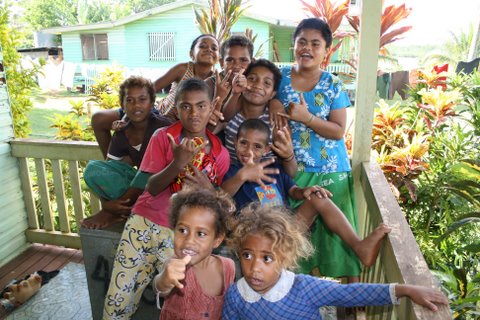
In the 1960s there was one household with two children at the Vatuadova reserve land west of Labasa. Ten years later there were four households there, all from the Nadogo mataqali. Today there are eight households, a church, fresh water from a bore, electricity, several sugar cane contracts, extra blocks of land, and scores of children. Here are some of the children - all home this week I guess because of the floods in Labasa disrupting schools in the district.


Monday, February 05, 2007

Cane toads in Fiji and in Queensland


from w

There's one creature in Fiji that I really do not like though perhaps some people might think they have great personalities just like someone in Vanuatu reckons Peter Foster is a charming man!

They are of course in Queensland, Australia also. The first time I saw them was at a Fiji school where the toilets were just cement footprints on a slab and cane toads were hopping about which was very scary. In Australia they are gradually moving from Queensland and even into Northern Territory.

The Cane Toad has large poison glands, and adults and tadpoles are highly toxic to most animals if ingested. Because of its voracious appetite, the Cane Toad has been introduced to many regions of the Pacific and the Caribbean islands as a method of agricultural pest control, notably in the case of Australia in 1935, and derives its common name from its use against sugar cane pests. The Cane Toad itself is now considered a pest in many of its introduced regions, as its toxic skin kills many native predators when ingested.

Perhaps as the Interim government in Fiji is looking for creating wealth if other industries such as sugar and gold collapse, they could set up a factory to make flip-flops out of cane toad skin. Ugh!

Sunday, February 04, 2007

Should the town of Labasa be moved to higher ground?


from w
There's a rhythm of flood and drought in babasiga land and that's taken for granted, but what a nuisance it is every summer or so.

The refrain I used to sing often - 'Don't let the rains come down, my roof's got a hole in it and I might drown!'

Because Labasa grew spasmodically from a few buildings at Malau port then the Mill area with their staff taking up residence in the nice hills east of Labasa River. But the low-lying area - once mangrove and flood-prone land west of the river - grew with with a few Chinese and Indian shops in the 40s, then today it is a commercial town. So flooding of the river always causes damage and dismay.

The Fiji papers are telling the story of the latest flood in Labasa and as usual there is damage to the crops. Isa lei, why don't they move the town to higher ground?


Crops, Homes & Shops Damaged in Labasa Flash Floods
By fijivillage
Feb 5, 2007, 07:35

There has been wide spread damage to crops in the northern division while shops in Labasa town have also suffered major damage as a result of the flash floods last night.

Commissioner Northern Misaele Naivalu speaking to Village News from the middle of Labasa town this morning confirms that the water level is slowly receding. He said that many shops and homes still have water inside while a large amount of crops have also been destroyed. Naivalu said officials are still trying to gather information on the exact number of people still taking shelter at the evacuation centres at Sangam College, Holy Family School and Labasa Civic Centre.

Commissioner Northern Misaele Naivalu said it would be wise for all schools in Labasa to be closed today.

Although the Education Ministry is yet to release a statement on the schools in the northern division, Naivalu said they are currently trying to ensure that all schools in the north remain closed today.
----
and from Fiji Times
A statement from the Ministry of Provincial Development has cautioned people to stay away from Labasa town as it is still underwater.

Bus operators have been advised that all major roads on Vanua Levu including Navidamu, Coloci, Dradramea roads are still underwater and closed to buses.

The Ministry says Korovuli Bridge in Seaqaqa, the Labasa/Savusavu highway at the Tabia roadn junction, roads along the Qawa and Labasa rivers, Labasa town, Bulileka and Valebasoga roads, Buca and Tukavesi areas are not accessible to buses and other vehicles.

Friday, February 02, 2007

Rocky Balboa


The DVD of Rocky Balboa is not my kind of film as I dislike boxing and violence, but there are some good scenes and script in the film. Junior saw it in Fiji recently and he told me to notice the good script. Instead of watching it all I just looked up stuff about the film on Google such as wikipedia.

I was interested in a scene between Rocky and his son.

Robert (Milo Ventimiglia). Robert is the opposite of Rocky - a buttoned-down, corporate-minded businessman who is trying to carve out his own place in a very different world. Rocky's relationship with Robert is tumultuous because Robert has always had to live under the shadow of his famed father; he even believes that the only reason he was hired for his latest job was because of his last name, Balboa. But it is through the course of the movie that we see the relationship mend itself through Rocky's admonishment to his son that his life is his own and he must be willing to take the chances necessary for an opportunity to succeed.
Rocky’s speech to his son

Here's an example of the script:

Somewhere along the line you changed. You stopped being you. You let people stick a finger in your face and tell you you’re no good and things got hard, you started looking for things to blame. Like a big shadow.

Let me tell you something you already know. The world ain’t all sunshine and rainbows. It’s very mean and nasty place. And I don’t care how tough you are it will beat you to your knees and keep you there permanently if you let it. You, me or nobody is going to hit as hard as life.

But it ain’t about how hard you hit. It’s about how hard you can get hit and keep amoving forwards, how much you can take and keep moving forward. That’s how winning is done.

Now if you know what you’re worth, you gotta be out there willing to take the hits and not point fingers ‘cos of him or her or anybody if you aint’ where you wanna be. Cowards do that. That ain’t you. You’re better than that.

Thursday, February 01, 2007

'Courage brother do not stumble' a Methodist hymn

The Fiji Methodist Church has come out with a strong statement about the current situation. It seems that this caused some disquiet in the military camp and soldiers went into Centenary Church this afternoon and a Fiji Times photographer was allegedly assaulted in the process.

Resign, Methodist Church tells regime
Friday February 02, 2007
Fiji’s largest Christian denomination, the Methodist Church has issued a strongly worded statement denouncing the December 5 coup by the military.

The church said the actions of the Commander to depose and then reinstate the President, to terminate the Soqosoqo Duavata ni Lewenivanua Government and Multi Party Cabinet and the dissolution of Parliament are questionable in any court of law.

"These actions must be viewed as a dangerous precedent to the governance of this country i.e. the use of military power to usurp the mandate of a democratically elected government.

‘The takeover should be deplored as a treasonous act against the State.

The Methodist Church said the coup in the short term created more poverty and this was evident from the growing number of people seeking assistance through the Church.

On the interim regime, the Church said in principle it agreed to the appointment because it acknowledges that democratic normalcy needs to be restored to the nation with undisturbed speed.

The Church called on the President and the Great Council of Chiefs to "show integrity, compassion and to stand up for the rule of law and Godly principles, including human rights, in this difficult period.

It also called for serious consideration to have the President medically boarded, and if necessary retired with dignity and respect.

"This plea is in the national interest and in the interest of the credibility of the interim regime.

"It is the humble and honest advice of the Church that this matter should be addressed to avoid certain embarrassment," the statement said.

The Methodist Church also called on Commodore Voreqe Bainimarama and his interim ministers to resign and appoint a new government that is politically neutral made up of prominent and respected people in society.

A senior army officer was infuriated when contacted for comments and blamed the president of the Assembly of Christian Churches in Fiji (ACCF) Reverend Tuikilakila Waqairatu for releasing the statement.

Senior Methodist Church ministers were not in a position to comment.

Methodist president Reverend Laisiasa Ratabacaca declined to comment.

Rev Ame Tugaue said he would rather not comment.

"Try the president or somebody else in the Church", he said.

Numerous calls made to the ACCF office were unanswered.

Wednesday, January 31, 2007

Romanu a top cop for the job in Fiji


from w
An excellent man, smart, generous, and knowledgable, Romanu starts work next week in Fiji as the new Police Commissioner.
from Fijilive
It’s a challenge: Tikotikoca
Thursday February 01, 2007

Fiji’s incoming Police Commissioner Romanu Tikotikoca expects a tough encounter when he officially takes up his new appointment soon. He is currently meeting the Constitutional Offices Commission to discuss his new role. Tikotikoca is most likely to start work next week. He said he is determined to carry out his duty diligently for the betterment of the nation.

Speaking to Fijilive this morning, Tikotikoca said he was ready to take up the challenge. "Of course I would have to get a briefing from my senior officers first before I actually begin on what path to take. "It won’t be easy but I am confident with the support of the Force," he said.

Tikotikoca will succeed Lieutenant Colonel Jimi Koroi, who will now be assisting in investigations into allegations of corruption prepared by the military following complaints from the public.

Tikotikoca resigned from the Fiji police to take up an appointment as head of security at the Gold Ridge Mine in the Solomon Islands over a year ago. He had also served with the Regional Assistance Mission to the Solomon Islands (RAMSI).

Spinning like a top - Elizabeth Keenan's article

Check out p 44 of ?Time February 5 2007, a spin on the military coup in Fiji or here.

One year since we started the babasiga blog


from w
Twelve months have gone by and bit by bit we learnt how to post pictures, place in links, etc. Have we wasted out time though? Peceli was keen for a few months and posted and now he seems to have left it to me! Sobosobo! The initial purpose was to promote Macuata/Labasa/babasiga with good news, but it is not always so in Vanua Levu or for that matter, Fiji as a whole.

Anyway the second blog, mainly about Geelong, developed later on and at least it got me back to the easel.

I wonder sometimes am I talking to meself and/or to strangers and some cheeky ones who post as 'anonymous'. Perhaps I should instead be going out into the streets and lanes of Geelong, visiting the sick and lonely.

Tuesday, January 30, 2007

The Snake God Temple near Labasa

from w
Peceli picked up a travel book, 'Across the South Pacific' from the shelf and browsed through a chapter about Labasa and I read it also. A family touring the Pacific had written about their adventures including staying in Labasa. This was about 20 years ago. Paul Jaduram is in the story and hey, you never know where your words and stories will end up!

Excerpt by Iain Finlay and Trish Sheppard - from their visit to Labasa where they stayed at the Takia Hotel and met Paul Jaduram. This is the writer's interpretation of a visit to a Hindu temple at Matailabasa.


Paul stopped the car at a small Hindu temple by the roadside. 'This is the Temple of the Snake,' he said. 'A very sacred place for Indians here.'

It was a small unimpressive building of cement which looked more like a little suburban house than a temple. It had been painted in rather garish colours. At the doorway we slipped our shoes off and left them outside while we stepped into the one main room of the building. It was almost filled from floor to ceiling with a huge, natural rock. In fact the whole structure had been erected over and around the rock, which quite clearly resembled a giant cobra with its head upright and its hood spread wide.

'The story is that the stone is growing,' Paul said quietly. 'People come from all over Fiji - and even from Indian, to see it. They believe that it can perform all manner of miracles, from curing sickness, to bringing rain for their crops. It is famous throughout Fiji as a rain god and it's also supposed to bring babies to sterile couples!'

We circled around the great figure for a few minutes, watching several sari-clad Indian women, placing incense sticks in sand containers and pressing their palms together in silent supplication to the Snake God.

'My grandmother used to bring me here,' Paul whispered. 'She told me all the stories about it… because she believed it…every bit of it. She was very traditional in her ways. She came to Fiji when she was only eleven.'

We had moved around the stone and back out onto the small verandah where we began to put our shoes back on. 'Did all of her family come at the same time?' I asked.

'Oh, no. None of them came. She was pinched from her village in India…kidnapped.'

'But why?' Trish said, amazed. 'Surely not to work here.'

'No, of course not. As a bride.'

'A bride! At eleven!'

'Yes. There were so many men who were coming here as labourers that there was a flourishing black market in illicit child brides.'

But couldn't her family do anything?'

'They never knew what happened to her. She never saw them, or heard of them again.'

'But how terrible. What happened to her? Obviously things turned out reasonably in the end because you're here…and..well, as you said, she used to bring you to the temple and so on. Did she stay married to the same man?'

'Yes. And eventually, after this period of indenture was over, they grew to be very rich and influential. It is a real success story.'

Obviously there is much more to a story like that but there's no doubt that the original Jadurams on Vanua Levu made the best of a bad job because the name Jaduram is all over the town of Labasa. There are streets named after various members of the family. Jaduram office buildings, cinemas, and also creches, which the old lady, Paul's grandmother founded and ran for Indian women in poorer situations than she. She was quite obviously a remarkable woman, and it was equally obvious that Paul thought so too and, for all his Western ways, gave the strong impression that he shared his grandmother's beliefs in the power of the Snake God.

Monday, January 29, 2007

Dear Mr Prime Minister - please save our little fishes

from w.
in today's Fiji Times
It's so strange these days that every grievance goes to the military - pollution and bad company practice regarding the environment - well, it's been going on for years, and no-one ever does much about it. Anyway, someone near Malau Timber Mill has written a letter to the self-appointed Prime Minister. My word, won't be be busy answering all these letters. Some complain about neighbours/colleagues/spouses. At least this one from Labasa ought to be answered by some-one! I would like to hear FFI's response to the complaint.

Certainly there is pollution in the waters off Labasa and people also throw things overboard from boats between Mali Island and the mainland. When I walked along the shore west of Nukutatava I noticed rubbish caught up in the mangroves. Isa lei, it should be a pristine shore environment.

I've written in an early post about the pollution caused by the Labasa Sugar Mill in the Qawa River and the science students of All Saints Secondary have been monitoring the situation.

Landowners seek PM's intervention
1205 FJT
Tuesday, January 30, 2007

Update: 12.05pm A landowning unit has sought the intervention of the interim Prime Minister to stop a timber company from killing their marine resources. The landowners from Malau, outside Labasa town, claim Fiji Forest Industries has been spilling chemicals into the sea nearby, resulting in the death of fish, seashells and other marine life they depend on for their survival.

The landowners say they had written to Prime Minister, Commander Voreqe Bainimarama, requesting his intervention in the matter. They claim the issue had been raised with the relevant authorities during the past eight years but nothing had been done about it.

The landowners are hopeful Commander Bainimarama will address their grievance.

The chief executive officer in the Prime Minister's office is in a meeting and will not be available to comment until later this afternoon.

Questions have been sent to FFI for their comment.

Are there land snakes in Fiji?

from w
Are there land snakes in Fiji?

Well, one day we found one up a tree at Nukutatava Beach. It was such an unusual find that we took it to All Saints High School to show the science teacher. That was the only time I ever saw a snake in Fiji though the mythology of snakes certainly persists with the story of Degei in the Kauvadra mountains and the Indian temple out of Labasa which is dedicated to a snake.

Anyway, Dr Paddy Ryan writes about the Fijian Burrowing Snake (bolo), Ogmodon vitianus.

One of the myths perpetuated in Fiji even by people who should know better is the mongoose myth…... As with most myths, even modern ones, there is a grain of truth in the story. We do have a terrestrial venomous snake, which must come as a bit of a shock to those people who claim that Fiji is snake-free apart from the pacific boa. What is even more surprising is that the snake is an elapid. In other words it belongs to the same family as the Indian cobra and the Australian taipan. Never fear though, until recently less than twenty specimens of this snake, Ogmodon vitianus were known to science.

From the records of the early naturalists we knew that Ogmodon, bolo in Fijian, was probably a burrowing snake. As a result it would be very rarely seen even if it was quite common. Its burrowing nature was confirmed when a specimen, found a metre down in soapstone rubble, was brought into the Fiji Museum. Unfortunately, the owner would neither let colleague John Gibbons nor me photograph the snake. To add insult to injury the snake escaped from its container and was probably snapped up by a passing mongoose. John Gibbons though was a very persistent man and he launched a one-man "find Ogmodon" campaign throughout central Vitilevu. In time he was successful, a juvenile about 15cm long was brought into the Biology Department at the University of the South Pacific by a villager from the interior. Juvenile bolo can be distinguished from the adults by the possession of a cream chevron between the eyes. Juveniles are also darker than adults, almost black compared with a smokey-grey. Unfortunately this specimen soon died, almost certainly from dehydration, although neither of us realised it then.

Two Fiji animals - the bold and the beautiful


from w
The pastel picture is too big to scan in one piece (more than A3) so I'm afraid I scanned it as four sections. Sorry. A mongoose and a little lizard. One is bold and the other is beautiful!

(added later)
There are at least two kinds of iguanas in Fiji, the brachylophus fasciatus which is blue and the brachylophus vitiensis which is green and white and crested and can change colour. Their ancestors may have drifted to Fiji from South America.


The small Indian mongoose was introduced to Fiji, so they say, to get rid of the snakes in the sugar-cane fields. But that is a myth, according to Dr Paddy Ryan who says it was introduced to get rid of rats. They say that a pair were brought from Calcutta in 1883 after the failure to breed them from 1870. The mongoose has a suitable name in my opinion - Herpestes javanicus as it is certainly a pest in Fiji. Mongeese often stole the eggs from our chickens when we lived in Vatuadova near Labasa, and I've seen them running in and out of a cafe in Labasa town. It’s a predator of birds, small mammals and reptiles so iguanas are at risk from mongeese. They even eat the eggs of sea turtles. They live to be about four years. This species has been nominated as among 100 of the "World's Worst" invaders.

There is a children’s story about the mongoose and the iguana by Ann Mason 2006 and she has given three optional endings. The website is intended for discussion by children.

Saturday, January 27, 2007

A very old photo from Lelean Memorial School


from w
Does anyone recognize any of the meke dancers from this photo taken many years ago at Lelean Memorial School at their 21st birthday celebration. Perhaps in 1964?
The boys are performing a vakamalolo sitting dance and a teacher, Dau Autiko, is in the middle.

Ecrea gives voice to their view of Fiji's situation

from w

ECREA keen to work with interim Govt
Sunday January 28, 2007

from one of the Fiji papers today (can't remember which one) This is from the Ecumenical Centre for Research Education and Advocacy - good guys and smart. They did not approve of the coup, but now want things to move ahead to get it right. My views generally co-incide with the things they say. I think the title in the newspaper is misleading - I don't know whether they are 'keen to work with interim Govt' but rather - 'Okay, let's move forward in the best way we can.'
----------

A Non-Government Organisation which promotes social justice says it’s willing to work with the Interim Administration appointed by Fiji’s President on the understanding that democratic rule is restored as soon as possible.

The director for the Ecumenical Centre for Research Education and Advocacy (ECREA), Mikaele Bulavakarua said the Interim Administration must also be held accountable to the vision it proposed for Fiji.

ECREA welcomed the return of executive authority to the President after the December 5 coup.

Bulavakarua said the NGO recognised the appointment of the Interim Administration is a critical step towards the return of parliamentary democracy.

However, he said ECREA deeply regretted the illegal overthrow of the democratically elected government and the legal and constitutional difficulties that have arisen since the takeover.

Bulavakarua called for an immediate end to all forms of human rights abuses and the need for a tangible timeline for a return to democracy through free and fair elections.

He called on the Interim Administration to clarify the continued presence of the military and the ambiguity surrounding the State of Emergency.

ECREA also expressed concern about the lack of evidence provided to the people about corruption investigations that saw the abrupt removal of certain people from their employment.

The organisation also called on interim Finance Minister Mahendra Chaudhry to resign as secretary of the National Farmers Union.

Bulavakarua also said ECREA recognised that under the former government, democratic processes had been manipulated.

He said despite opposition through democratic means like submissions, dialogue, the elected government failed to reconsider its racially divisive legislation and the impact of its economic decision on the ordinary people.

Wednesday, January 24, 2007

Now they want people to retire at 55


from w
The next step of the Interim guys in Fiji is to reduce the size of the civil service so they want to make civil servants retire at 55. At present it is 60. There's one good reason in my mind regarding teachers, and that is to give the new graduates a chance to get a job. But on the other hand some teachers, nurses, doctors, administrators at 55 are still doing an excellent job.

Okay, if people want to retire at 55 (and perhaps they do get a small - or - large pension) but some people love their job, and also have on-going financial obligations so that to retire makes their whole life difficult.

Of course some might want to sit and watch the sun rise and the sun set each day as they order round the young ones to do their fetching and carrying!

It is good to change direction about that age - take on voluntary work, community work, farming or gardening, art or music, go back to tertiary studies, or even activism. I'm sure that some of the outspoken men and women in Fiji are near or past 55!

Of course it makes some positions in Fiji look a little odd if 55 is considered your use-by date for a job. Hmmm. The office of the President comes to mind!

Some parents are helicopter parents


from w
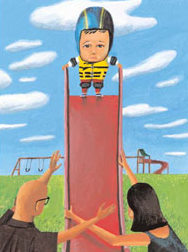
I wonder how many Fiji parents are like helicopters, hovering over their precious children, watching their every move, taking their lunches at midday to them, doing their homework for them? I guess parents need to give their children space some of the time to make their own decisions, to experience failure, the consequences of bad decisions, to be realistic and resilient.

Helicopter parents

Some American and Australian parents are tracking their children in a device in their shoes or a tracking device around their necks. When you're not with them, you can be comforted by their red blip on your screen. When they move out of their designated safe zones, your child can be reeled back into the sanitised world and therefore bypass any chance of imagination-stimulating adventure.

And what is helicopter parenting?

Parents who, even with their teens boarding at uni, drive two hours to tidy their dorms and do their laundry. They hover over their children, whether young, teenage, or adult!

Imagine the ramifications of tracking devices and helicopter parents on Huck Finn. He and Jim would never have built their raft and sailed the Mississippi. And Alice might never have followed the white rabbit down the hole under the hedge, and there wouldn't have been a Famous Five or Secret Seven. Had Dorothy been attached to a tracking device, Lucy, Edmund, Susan and Peter would never have had the freedom to stumble through the winter coats into Narnia.

Notes adapted from
Kids denied 'real world' lessons By Cheryl Critchley January 05, 2007 12:00am Melbourne

Well-meaning parents are smothering children by over-protecting and doing everything for them. Deakin University education lecturer Dr Helen McGrath says "paranoid parenting" was so bad many children had few life skills and some were ending up depressed.

Some parents:

• DISCOURAGE children from taking the slightest physical risks, such as walking down the street.

• COMPLAIN to schools if their child is punished for being naughty.

• TAKE items banned on excursions like cameras to the location for them.

• INVESTIGATE why their upset child wasn't elected school captain.

• CRY bullying if their child has one run-in with another child.

• DELIVER fast food for school lunch to show how much they love their child.

Dr McGrath said parents had to allow their children to make mistakes, miss out and learn from the experience. "How on earth do you become a successful human being if you can't face life's risks?" she said. "I think most parents are actually quite lost. They intuitively feel that they're not getting it right. Being resilient means coping with negative events in one's life and 'bouncing back' to a state of emotional wellbeing," Dr McGrath says. "Young people who have the skills to be resilient have a lower likelihood of becoming depressed or suicidal and a higher likelihood of having more satisfying lives and greater emotional wellbeing.’

Tuesday, January 23, 2007

Dudley High School and the feisty Miss Dudley

from w
When I think about the opening of the school year in Fiji I think of Dudley High School, one of the best schools in Suva. Many of Fiji's finest women have come through the corridors of this school in Toorak, strong, articulate, professional women.

So who was Miss Dudley? The first book I read about her was sentimental and charming but later on I read a more informative book about her that revealed that she was a feisty Australian woman who deeply cared about the Indian community in Fiji. This was about a hundred years ago. She was of an independent spirit, and would not do what the 'committee men' of the Methodist church told her to do. She even packed up and choofed off with some of the adopted children rather than submit to their requirements that she move away from Suva. Dudley High School is named after her and also the Methodist Church in Amy Street, Toorak.

I came across this interesting letter written by Hannah Dudley that describes the time of Indian indentured labour in Fiji. It was sent by Hannah Dudley to the Modern Review on 4 November 1912
Source: T. Sanadhya, My twenty-one years in the Fiji Islands, Fiji Museum, 1991

Sir,

Living in a country where the system called “Indentured labour” is in vogue, one is continually oppressed in spirit by the fraud, injustice, and inhumanity of which fellow creatures are the victims.
Fifteen years ago, I came to Fiji to do the mission work among the Indian people here. I had previously lived in India for five years. Knowing the natural timidity of Indian village people and knowing also that they had no knowledge of any country beyond their own immediate district, it is a matter of great wonder to me as to how these people could have been induced to come thousands of miles from their own country to Fiji. The women were pleased to see me as I had lived in India and could talk to them of their own country. They would tell me of their troubles and how they had been entrapped by the recruiter or his agents. I will cite a few cases.
One woman told me she had quarrelled with her husband and in anger ran away from her mother-in-law’s home to go to her mother’s. A man on the road questioned her, and said he would show her the way. He took her to a depot for Indentured labour. Another woman said her husband went to work at another place. He sent word to his wife to follow him. On her way a man said he knew her husband and that he would take her to him. This woman was taken to a depot. She said that one day she saw her husband passing and cried out to but was silenced. An Indian girl, was asked by a neighbour to go and see the Muharram festival. While there she was prevailed upon to go to a depot. Another woman told me that she was going to a bathing ghat and was misled by a woman to a depot.
When in the depot these women were told that they can not go till they pay for the food they have had and for other expenses, they were unable to do so. They arrive in this country, timid, fearful women not knowing where they are to be sent to. They are allotted to plantations like so many dumb animals. If they do not perform satisfactorily the work given to them, they are punished by being struck or fined, or they are even sent to goal. The life on the plantations alters their demeanour and even their faces. Some look crushed and broken-hearted, others sullen, others hard and evil. I shall never forget the first time I saw “indentured” women. They were returning from their day’s work. The look on these women’s faces haunts me.
It is probably known to you that only about 33 women are brought to Fiji to every one hundred men. I can go to into details concerning this system of legalized prostitution. To give you some idea of the result, it will be sufficient to say that every few months some Indian man murders for unfaithfulness of the woman whim he regards as his wife.
It makes one burn with indignation to think of the helpless little children born under the revolting condition of the “indentured labour” system. I adopted two little girls – daughters of two unfortunate women who had been murdered. One was a sweet, graceful child so good and true. It is always a marvel to me how such a fair jewel could have come out of such loathsome environments. I took her with me to India some years ago, and there she died of tuberculosis. Her fair form was laid to rest on a hill side facing snow-capped Kinchin-chinga. The other child is still with me – now grown up to be a loyal true and pure girl. But what of the children – what of the girls – who are left to be brought up in such pollution?
After five years of slavery, after five years of legalised immorality – the people are “free”. And what kind of a community emerges after five years of such a life? Could it be a moral self-respecting one? Yet some argue in favour of this worse than barbarous system, that the free Indians are better off financially than they would be in their own country! I would ask you at what cost to the Indian people? What have their women forfeited? What is the heritage of their children?
And for what is all this suffering and wrong against humanity? To gain profits – pounds, shillings and pence. For sugar companies and planters and others interested.
I beseech of you not to be satisfied with any reforms to the system of indentured labour. I beg of you not to cease to use you influence against this iniquitous system till it be utterly abolished.
-- H. Dudley, Suva Fiji. November 4

Monday, January 22, 2007

School starts today in Fiji for 2007


from w
Some look forward to seeing their friends again, some don't, because keeping still for a few hours is hard to do! And classroom techniques are not as interesting as playing on the beach - or even, playing internet games for rich kids!

In Fiji schools opening up today for students - kinders, primary, secondary. Classes are very large at times - such as 50 boys in a class at Marist Primary in Suva for some classes. Our mataqali children go to many different kinds of schools - government, church, Hindu, Muslim, Fijian village. School uniforms are compulsory even in primary school and there are school fees to be paid, not a lot by vavalagi standards, but still hard to find for many families.

Peceli and I have had associations with various Methodist schools such as Lelean Memorial School, Dudley High School, Jasper Williams High School and I have also taught at Penang Sangam High School, Rakiraki, and All Saints High School, Labasa, so education in Fiji is a high priority in my view.

The pictures are of Mali Island kindergarten graduates last December who will be starting at Mali District School today. Another is of Kauvadra High School students on the day the Education Minister visited.

Isa lei, I hope the powers-that-be in Suva get their priorities right and put education, health, water supply and roads up there as most important rather than dobbing in your neighbour/workmate for some small misdemeanours to be 'cleaned up'!